
Many English learners and even professionals pause when they see affect and effect. They look similar. They sound related. But they do very different jobs in a sentence.
Knowing the difference helps you write clearly, speak confidently, and avoid common mistakes in emails, reports, essays, and conversations.
Using only one way to explain this difference can make your language feel repetitive or weak. Strong communicators use varied expressions to match the situation.
A casual chat needs simple wording. A business report needs precision. An academic paper needs formal clarity.
Word choice shapes tone. It can sound friendly, professional, confident, or unsure.
Quick contrast:
- Informal: Affect changes something. Effect is the result.
- Formal: Affect refers to influence, while effect refers to the outcome.
This guide will help you understand the meaning and give you many natural alternatives you can use anywhere.
What Does “Affect vs Effect” Mean?
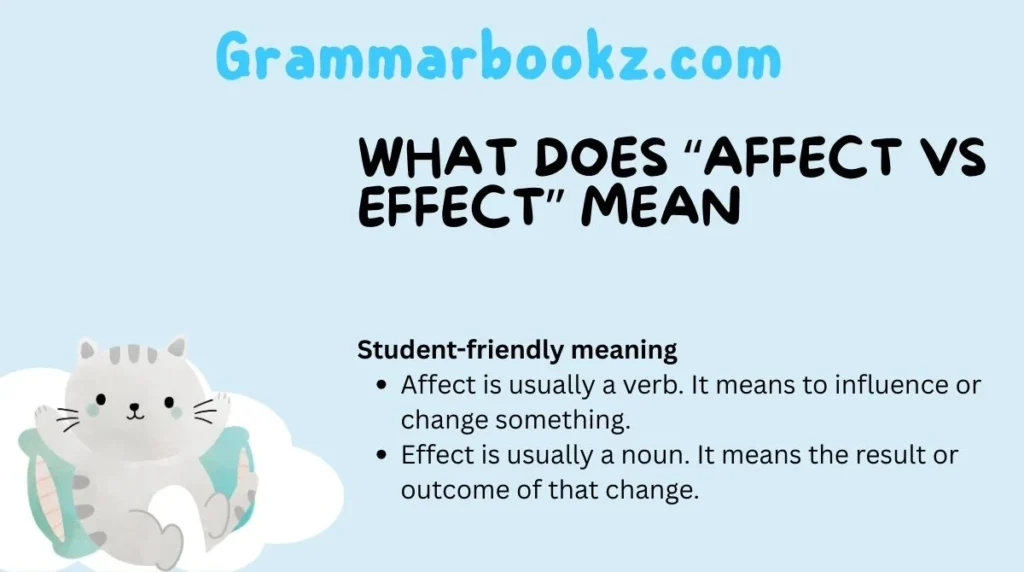
Student-friendly meaning
- Affect is usually a verb. It means to influence or change something.
- Effect is usually a noun. It means the result or outcome of that change.
Grammar form
- Affect → verb
- Effect → noun
(Advanced note: effect can sometimes be a verb, but that is rare and formal.)
Simple synonyms
- Affect → influence, impact, change
- Effect → result, outcome, consequence
Opposite idea
- Affect → to leave unchanged
- Effect → cause (in reverse meaning)
Sample sentences
- Stress can affect your health.
- The effect of stress can be serious.
When to Use “Affect vs Effect”
Spoken English
Use short, simple explanations. People want clarity, not grammar lessons.
Business English
Use precise language. Mistakes here reduce credibility.
Emails / Messages
Clear explanations prevent confusion and follow-up questions.
Social Media
Simple phrasing works best. Overly formal explanations feel heavy.
Academic Writing
Correct usage is essential. Errors can lower grades or trust.
Professional Meetings
Use confident wording to explain cause and result clearly.
Is “Affect vs Effect” Polite or Professional?
The phrase itself is neutral and educational.
Tone levels
- Polite: Yes
- Neutral: Yes
- Strong: No
- Soft: Yes
- Formal: Yes
- Informal: Yes
Etiquette tip
Perfect for classrooms, training, and professional discussions.
Avoid joking explanations in serious reports.
Pros & Cons of Using “Affect vs Effect”
✔ Pros
- Improves clarity
- Prevents common errors
- Builds professional credibility
- Useful in exams and work
✘ Cons
- Can feel confusing to beginners
- Over-explaining can slow communication
Quick Alternatives List
- Influence vs result
- Cause vs outcome
- Action vs consequence
- Impact vs result
- Change vs effect
- What changes vs what happens
- Reason vs result
- Input vs output
- Lead to vs result in
- Shape vs outcome
- Modify vs effect
- Alter vs consequence
- Have an impact on vs result of
- Affect means change, effect means result
- One causes, the other shows
- Process vs outcome
Influence vs Result
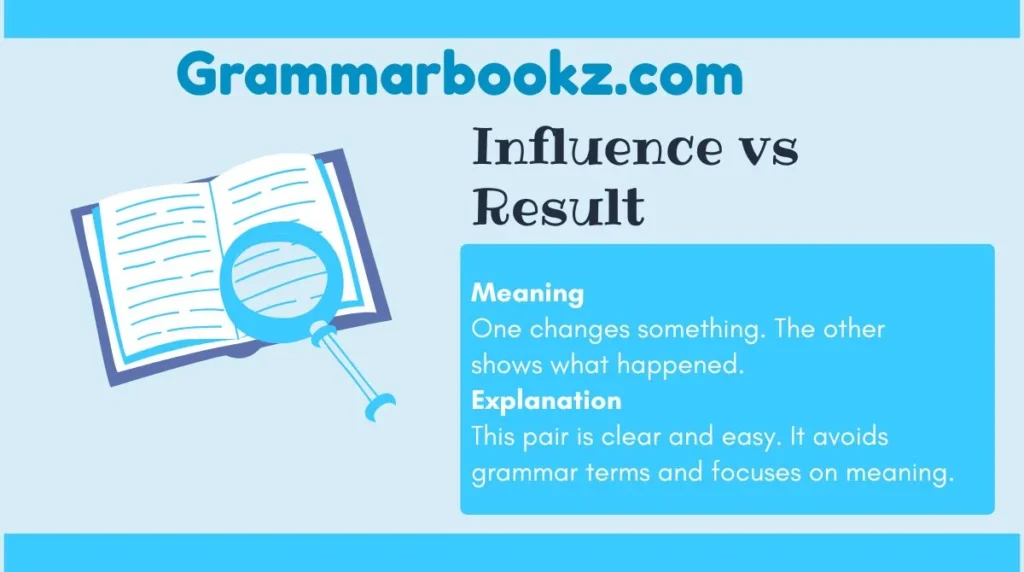
Meaning
One changes something. The other shows what happened.
Explanation
This pair is clear and easy. It avoids grammar terms and focuses on meaning.
Grammar Note
Noun vs noun
Example Sentence
Lack of sleep has an influence on mood. The result is poor focus.
Best Use
Workplace, teaching, general explanation
Worst Use
Very casual chat
Tone
Professional, clear
Level
Beginner
Similarity Score
9/10
Replaceability Tip
Use this when teaching beginners.
Cause vs Outcome
Meaning
One is why something happens. The other is what happens.
Explanation
This is logical and structured. Great for reports and analysis.
Grammar Note
Noun phrase
Example Sentence
Stress is the cause. Burnout is the outcome.
Best Use
Academic, business writing
Worst Use
Text messages
Tone
Formal
Level
Intermediate
Similarity Score
8/10
Replaceability Tip
Use in presentations and reports.
Impact vs Result
Meaning
Impact shows force or influence. Result shows the end effect.
Explanation
Stronger than “affect.” Sounds confident.
Grammar Note
Noun
Example Sentence
The policy had a major impact. The result was higher costs.
Best Use
Business, professional emails
Worst Use
Casual talk
Tone
Professional
Level
Intermediate
Similarity Score
8/10
Change vs Effect
Meaning
One alters something. The other shows what changed.
Explanation
Very simple and learner-friendly.
Grammar Note
Noun
Example Sentence
Exercise causes a change. Better health is the effect.
Best Use
Teaching, basic explanation
Worst Use
Formal academic papers
Tone
Neutral
Level
Beginner
Similarity Score
7/10
Have an Impact on vs Result in
Meaning
One influences. The other produces an outcome.
Explanation
This pair sounds polished and professional.
Grammar Note
Verb phrases
Example Sentence
Stress can have an impact on focus and result in mistakes.
Best Use
Emails, reports
Worst Use
Very casual speech
Tone
Professional
Level
Advanced
Similarity Score
9/10
Lead to vs Be the Result of
Meaning
One causes. The other explains the outcome.
Explanation
Clear cause-effect structure.
Grammar Note
Verb phrases
Example Sentence
Poor planning leads to delays. Delays are the result of poor planning.
Best Use
Business, presentations
Worst Use
Short texts
Tone
Formal
Level
Intermediate
Similarity Score
9/10
Shape vs Outcome
Meaning
Shape means influence over time. Outcome is the final result.
Explanation
More abstract and thoughtful.
Grammar Note
Verb + noun
Example Sentence
Habits shape success. The outcome depends on discipline.
Best Use
Essays, speeches
Worst Use
Quick explanations
Tone
Professional
Level
Advanced
Similarity Score
7/10
Modify vs Consequence
Meaning
One changes something. The other follows after.
Explanation
Formal and precise.
Grammar Note
Verb + noun
Example Sentence
The rule modified behavior. The consequence was improvement.
Best Use
Legal or policy writing
Worst Use
Casual talk
Tone
Formal
Level
Advanced
Similarity Score
7/10
What Changes vs What Happens
Meaning
Simple cause-result idea.
Explanation
Very easy for beginners.
Grammar Note
Question phrase
Example Sentence
Affect is what changes. Effect is what happens.
Best Use
Teaching, ESL learners
Worst Use
Professional writing
Tone
Friendly
Level
Beginner
Similarity Score
8/10
Reason vs Result
Meaning
Why vs what.
Explanation
Clear logic, easy to remember.
Grammar Note
Noun
Example Sentence
Stress is the reason. Fatigue is the result.
Best Use
General explanation
Worst Use
Highly formal writing
Tone
Neutral
Level
Beginner
Similarity Score
8/10
Mini Dialogue Examples
Formal
- Teacher: What is the difference between affect and effect?
- Student: Affect shows influence. Effect shows the result.
Informal
- Friend: I always mix these up.
- You: Affect changes things. Effect is what happens after.
Business Email
The new schedule may affect productivity. One possible effect is reduced efficiency.
Mistakes to Avoid
- Using effect as a verb in casual writing
- Swapping affect and effect
- Over-explaining in emails
- Using slang in formal writing
- Ignoring audience level
- Assuming everyone knows grammar terms
Cultural & Tone Tips
US English
Direct explanations are preferred.
UK English
Slightly more formal phrasing is common.
Casual Social English
Simple explanations work best. Grammar terms are often skipped.
Comparison Table
| Phrase | Tone | Best Context | Professional Level | Example |
|---|---|---|---|---|
| Influence vs Result | Neutral | Teaching | Medium | Stress influences mood |
| Cause vs Outcome | Formal | Reports | High | Policy caused change |
| Impact vs Result | Professional | Business | High | Budget impacted sales |
| Lead to vs Result in | Formal | Emails | High | Errors led to delays |
| Change vs Effect | Friendly | ESL learning | Low | Exercise causes change |
FAQs
Is “affect vs effect” confusing?
Yes, at first. Practice makes it easy.
Is it okay in emails?
Yes, if explained clearly.
What is the most formal alternative?
Cause vs outcome.
What is the most polite alternative?
Influence vs result.
What should beginners use?
What changes vs what happens.
Can effect be a verb?
Yes, but it is rare and formal.
Conclusion
Understanding affect vs effect is a major step toward clear English. But strong communication goes beyond knowing one rule. Using alternatives helps you match tone, audience, and situation.
It improves fluency. It builds confidence. And it makes your English sound natural, not mechanical.
Practice these expressions in emails, conversations, and writing. Over time, the difference will feel automatic.
That is when English stops feeling difficult and starts feeling powerful.

John Lee is an education-focused writer with a strong interest in English grammar and language learning.
He creates clear, student-friendly content to help learners improve their grammar skills with confidence.