
The phrase “as soon as possible” is one of the most common expressions in English. You hear it at work. You read it in emails. You say it in daily life. It simply means without delay or at the earliest time.
But there’s a problem. When you use it too often, it can sound rushed, vague, impatient, or even unprofessional—especially in business or academic settings.
Native speakers often choose different expressions based on tone, urgency, and relationship.
Using varied alternatives helps you sound clearer, more polite, and more confident. It also shows strong language skills. The right phrase can soften a request or make it stronger—without sounding rude.
Formal: “Please respond at your earliest convenience.”
Informal: “Let me know ASAP.”
In this guide, you’ll learn natural, professional, and everyday alternatives—so you always choose the right words for the right situation.
Another Way to Say “As Soon As Possible” Professionally
In professional communication, using alternatives to “as soon as possible” can make your message sound more polite, clear, and professional. While the phrase is common, repeating it too often in emails, reports, or workplace messages may seem rushed or slightly informal. Instead, you can use phrases like “at your earliest convenience,” “promptly,” “as soon as you are able,” or “at the earliest opportunity.” These alternatives maintain urgency while still sounding respectful and professional.
For example, in a business email you might write, “Please send the updated document at your earliest convenience,” or “Kindly review the report promptly.” Such phrases communicate the need for timely action without sounding demanding. Choosing the right wording depends on the situation, the level of urgency, and your relationship with the recipient. Using professional alternatives not only improves the tone of your communication but also helps your writing appear more polished and workplace-appropriate.
What Does “As Soon As Possible” Mean?
Simple meaning:
It means at the earliest time you can or without unnecessary delay.
Grammar form:
It is an adverbial phrase. It modifies verbs like reply, send, call, complete, or finish.
Similar expressions:
Immediately, promptly, right away, without delay
Opposite tone expressions:
Whenever you have time, later on, at your convenience
Sample sentences:
- Please send the report as soon as possible.
- Call me as soon as possible if there’s an update.
When to Use “As Soon As Possible”
Spoken English
Used in daily conversation to show urgency.
“Come here as soon as possible.”
Business English
Common but can sound pushy if overused.
“Please review this as soon as possible.”
Emails / Messages
Neutral, but vague. It does not give a clear deadline.
Social Media
Often shortened to ASAP.
Academic Writing
Usually avoided. Sounds informal and unclear.
Professional Meetings
Acceptable when urgency is obvious, but better with context.
Is “As Soon As Possible” Polite or Professional?
The tone depends on context.
- Polite: With “please” and softeners
- Neutral: Plain usage
- Strong: Sounds demanding without context
- Soft: When paired with understanding language
Formal vs Informal:
Formal emails prefer softer alternatives. Informal speech accepts it easily.
Etiquette tip:
Better for internal communication. Avoid in high-level corporate or client emails unless urgency is critical.
Pros & Cons of Using “As Soon As Possible”
✔ Pros:
- Easy to understand
- Expresses urgency clearly
- Widely accepted
✘ Cons:
- Sounds impatient
- Lacks a real deadline
- Overused and vague
- Can feel rude in emails
Quick Alternatives List (For Busy Readers)
- At your earliest convenience
- As soon as you can
- At the earliest opportunity
- Without delay
- Promptly
- Right away
- Immediately
- When possible
- At the soonest
- As quickly as possible
- At your earliest availability
- At the next opportunity
- As a priority
Strong Alternatives and How to Use Them
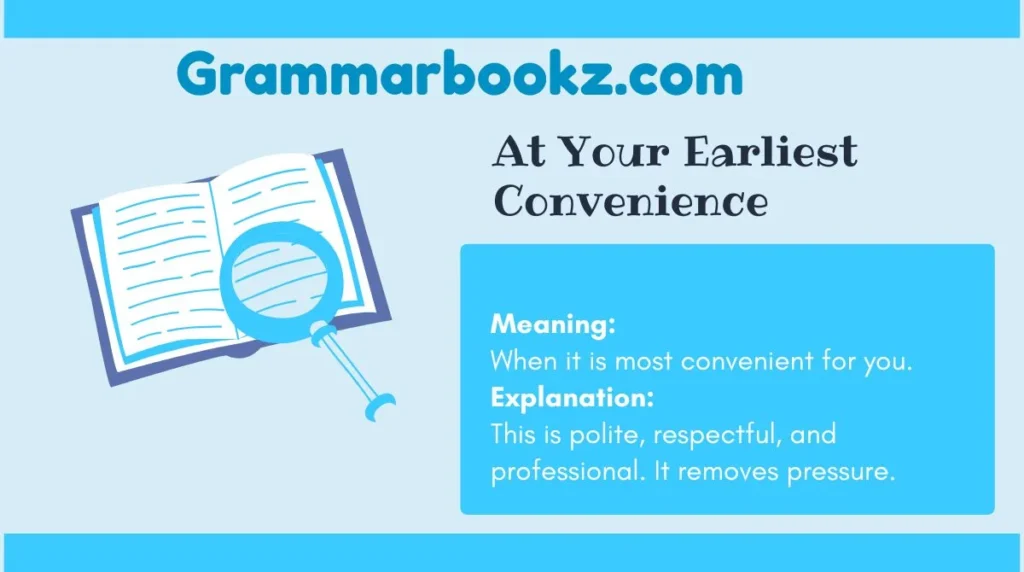
At Your Earliest Convenience
Meaning:
When it is most convenient for you.
Explanation:
This is polite, respectful, and professional. It removes pressure.
Grammar Note:
Formal adverbial phrase.
Example Sentence:
Please reply at your earliest convenience.
Best Use:
Formal emails, workplace, clients
Worst Use:
Emergency situations
Tone:
Polite, formal
Level:
Intermediate
Similarity Score:
7/10
Replaceability Tip:
Use this when politeness matters more than urgency.
As Soon As You Can
Meaning:
When you are able to do it.
Explanation:
Softer and more human than the original phrase.
Grammar Note:
Conversational phrase.
Example Sentence:
Let me know as soon as you can.
Best Use:
Spoken English, emails
Worst Use:
Strict deadlines
Tone:
Friendly
Level:
Beginner
Similarity Score:
8/10
Replaceability Tip:
Great when you want urgency without pressure.
At the Earliest Opportunity
Meaning:
At the first available chance.
Explanation:
Sounds professional and planned.
Grammar Note:
Formal phrase.
Example Sentence:
We will address this at the earliest opportunity.
Best Use:
Business, reports
Worst Use:
Casual texting
Tone:
Professional
Level:
Advanced
Similarity Score:
7/10
Replaceability Tip:
Use in official communication.
Without Delay
Meaning:
Immediately, no waiting.
Explanation:
Strong and firm. Often used in instructions.
Grammar Note:
Adverbial phrase.
Example Sentence:
Please inform management without delay.
Best Use:
Policies, warnings
Worst Use:
Friendly emails
Tone:
Strong
Level:
Advanced
Similarity Score:
9/10
Replaceability Tip:
Use when action is urgent and serious.
Promptly
Meaning:
Quickly and efficiently.
Explanation:
Short and professional.
Grammar Note:
Adverb.
Example Sentence:
The issue was promptly resolved.
Best Use:
Business writing
Worst Use:
Casual speech
Tone:
Professional
Level:
Intermediate
Similarity Score:
6/10
Replaceability Tip:
Good for reports and formal updates.
Right Away
Meaning:
Immediately.
Explanation:
Direct and casual.
Grammar Note:
Adverbial phrase.
Example Sentence:
I’ll do it right away.
Best Use:
Spoken English
Worst Use:
Formal emails
Tone:
Informal
Level:
Beginner
Similarity Score:
9/10
Replaceability Tip:
Use with friends or coworkers you know well.
Immediately
Meaning:
At once.
Explanation:
Very strong and time-sensitive.
Grammar Note:
Adverb.
Example Sentence:
The system must be updated immediately.
Best Use:
Emergency, rules
Worst Use:
Polite requests
Tone:
Strong
Level:
Intermediate
Similarity Score:
10/10
Replaceability Tip:
Use only when delay is unacceptable.
When Possible
Meaning:
If time allows.
Explanation:
Relaxed and flexible.
Grammar Note:
Conditional phrase.
Example Sentence:
Please call me when possible.
Best Use:
Casual messages
Worst Use:
Urgent tasks
Tone:
Soft
Level:
Beginner
Similarity Score:
4/10
Replaceability Tip:
Use when timing is flexible.
At the Soonest
Meaning:
As early as it can be done.
Explanation:
Sounds slightly informal but clear.
Grammar Note:
Idiomatic phrase.
Example Sentence:
We need confirmation at the soonest.
Best Use:
Spoken business English
Worst Use:
Academic writing
Tone:
Neutral
Level:
Intermediate
Similarity Score:
7/10
Replaceability Tip:
Works well in conversation.
As Quickly As Possible
Meaning:
With maximum speed.
Explanation:
Emphasizes effort, not pressure.
Grammar Note:
Adverbial phrase.
Example Sentence:
The team worked as quickly as possible.
Best Use:
Explanations, updates
Worst Use:
Commands
Tone:
Neutral
Level:
Intermediate
Similarity Score:
8/10
Replaceability Tip:
Use when describing action already taken.
At Your Earliest Availability
Meaning:
When you first have time.
Explanation:
Respectful and clear.
Grammar Note:
Formal phrase.
Example Sentence:
Let’s meet at your earliest availability.
Best Use:
Scheduling
Worst Use:
Casual chats
Tone:
Professional
Level:
Advanced
Similarity Score:
6/10
Replaceability Tip:
Ideal for meetings.
As a Priority
Meaning:
Before other tasks.
Explanation:
Workplace-focused and firm.
Grammar Note:
Prepositional phrase.
Example Sentence:
Please handle this as a priority.
Best Use:
Management communication
Worst Use:
Personal messages
Tone:
Strong professional
Level:
Advanced
Similarity Score:
7/10
Replaceability Tip:
Use to signal importance, not speed alone.
At the Next Opportunity
Meaning:
The next available time.
Explanation:
Balanced and calm.
Grammar Note:
Formal phrase.
Example Sentence:
We will discuss this at the next opportunity.
Best Use:
Meetings, planning
Worst Use:
Urgent matters
Tone:
Neutral
Level:
Intermediate
Similarity Score:
5/10
Replaceability Tip:
Use when timing depends on schedules.
Mini Dialogue Examples
Formal
Manager: Please submit the report at your earliest convenience.
Employee: Of course. I’ll prioritize it.
Informal
Alex: Can you call me as soon as you can?
Sam: Sure, right away.
Business Email Style
“Dear Sarah,
Please review the attached document at your earliest availability.
Best regards.”
Mistakes to Avoid
- Using “ASAP” in formal emails
- Sounding demanding without “please”
- Using strong phrases for small requests
- Mixing formal tone with slang
- Overusing one phrase repeatedly
- Forgetting cultural tone differences
Cultural & Tone Tips
US English:
Directness is common. “ASAP” is normal internally.
UK English:
Politeness matters more. Softer phrases are preferred.
Casual Social English:
Short phrases like “right away” sound natural.
Native speakers adjust tone based on relationship—not just urgency.
Comparison Table
| Phrase | Tone | Best Context | Professional Level | Example |
|---|---|---|---|---|
| At your earliest convenience | Polite | Emails | High | Please respond at your earliest convenience |
| Immediately | Strong | Emergencies | High | Action is required immediately |
| Right away | Informal | Speech | Low | I’ll do it right away |
| Promptly | Professional | Reports | Medium | The issue was promptly resolved |
| As a priority | Strong professional | Workplace | High | Treat this as a priority |
FAQs
Is “as soon as possible” rude?
No, but it can sound demanding without soft language.
Is it okay in emails?
Yes, but better alternatives exist for formal emails.
What is the most formal alternative?
“At your earliest convenience.”
What is the most polite alternative?
“At your earliest availability.”
What should beginners use?
“As soon as you can.”
Is ASAP informal?
Yes. Avoid it in formal writing.
Conclusion
Using different ways to say “as soon as possible” makes your English clearer and more natural. It helps you control tone, show respect, and sound confident in any situation.
The right phrase can turn a demanding request into a polite one—or add urgency when needed.
Strong language isn’t about fancy words. It’s about choosing the right words. Practice these alternatives in emails, conversations, and writing.
Over time, your fluency and professionalism will grow naturally.

John Lee is an education-focused writer with a strong interest in English grammar and language learning.
He creates clear, student-friendly content to help learners improve their grammar skills with confidence.