The phrase “did you get a chance to” is common in English. People use it to politely ask if someone has completed a task or looked at something.
It sounds friendly and non-pushy, which is why learners love it. But using the same phrase again and again can make your English feel repetitive, weak, or unclear—especially in professional settings.
Choosing the right alternative changes everything. It can make you sound more confident, more respectful, or more professional.
In emails, meetings, essays, and daily conversation, word choice affects tone, clarity, and how people respond to you.
For example:
Formal: “Have you had the opportunity to review the document?”
Informal: “Did you get a chance to look at it?”
Both are correct, but they send different signals. This guide will help you choose the best version for every situation.
What Does “Did You Get a Chance To” Mean?
Student-friendly meaning:
It means asking if someone had time or opportunity to do something.
Grammar form:
Verb phrase (past tense question)
Similar tone phrases:
- “Were you able to…”
- “Did you manage to…”
Opposite tone phrases (stronger):
- “Why haven’t you…”
- “You were supposed to…”
Examples:
- Did you get a chance to read my message?
- I just wanted to check if you got a chance to reply.
This phrase softens the request. It shows patience and respect for the other person’s time.
When to Use “Did You Get a Chance To”
Spoken English
Great for everyday conversation. Sounds natural and friendly.
Business English
Acceptable, but can feel too casual in formal workplaces.
Emails / Messages
Good for polite follow-ups, especially with people you know.
Social Media
Works well in DMs and comments.
Academic Writing
Not recommended. Too conversational.
Professional Meetings
Okay in relaxed meetings, but not ideal for senior-level discussions.
Is “Did You Get a Chance To” Polite or Professional?
This phrase is polite and soft, but not always professional.
Tone levels explained:
- Polite: Yes
- Neutral: Yes
- Strong: No
- Soft: Very
- Formal: Mild
- Informal: Yes
Etiquette tip:
Better for friendly workplaces and peer communication. Avoid using it in corporate emails with senior management or clients. Choose a more direct but respectful alternative instead.
Pros & Cons of Using “Did You Get a Chance To”
✔ Pros:
- Sounds friendly
- Reduces pressure
- Easy for beginners
- Common in spoken English
✘ Cons:
- Too casual for formal writing
- Can sound weak or vague
- Overused in emails
- Not ideal for deadlines
Quick Alternatives List (For Busy Readers)
- Were you able to…
- Have you had a chance to…
- Did you manage to…
- Have you reviewed…
- Have you completed…
- Could you confirm whether…
- I wanted to check if you…
- Just following up on…
- Have you looked into…
- May I ask if you’ve…
- Were you able to review…
- Any update on…
- I’m checking to see if…
- Have you had the opportunity to…
- Can you let me know if…
- Did you happen to…
- Have you gone through…
- I wanted to follow up regarding…
18 Strong Alternatives to “Did You Get a Chance To”
Were you able to…
Meaning:
Asks if someone succeeded in doing something.
Explanation:
This sounds slightly more professional and confident than the original phrase. It assumes effort, not delay.
Grammar note:
Verb phrase (past modal)
Example sentence:
Were you able to submit the report on time?
Best use:
Workplace, emails, meetings
Worst use:
Very casual chats
Tone:
Professional, polite
Level:
Beginner–Intermediate
Similarity score:
9/10
Replaceability tip:
Use this when discussing tasks or results.
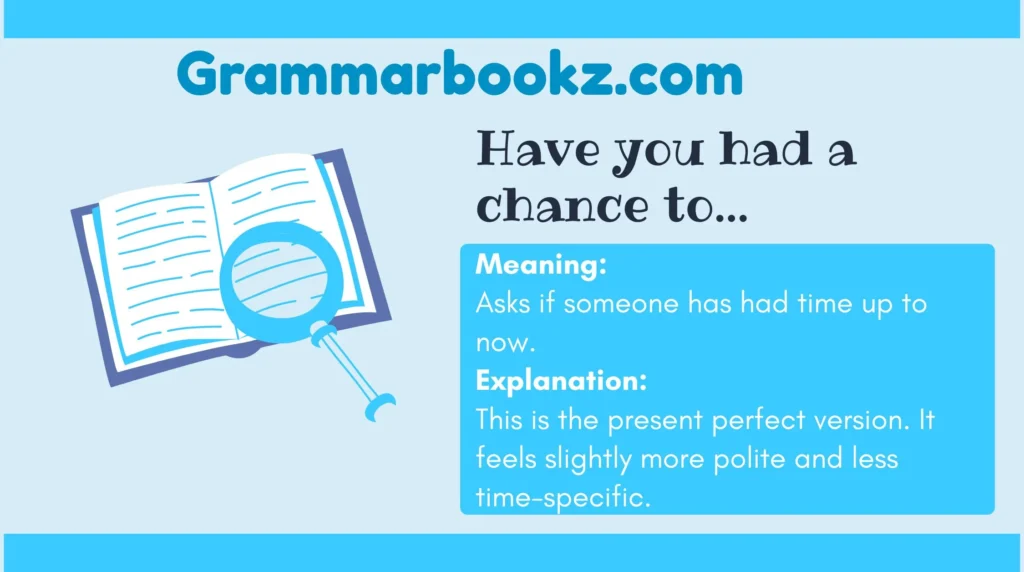
Have you had a chance to…
Meaning:
Asks if someone has had time up to now.
Explanation:
This is the present perfect version. It feels slightly more polite and less time-specific.
Grammar note:
Present perfect verb phrase
Example sentence:
Have you had a chance to review the proposal?
Best use:
Emails, follow-ups
Worst use:
Urgent situations
Tone:
Soft, polite
Level:
Beginner
Similarity score:
10/10
Replaceability tip:
Perfect for gentle reminders.
Did you manage to…
Meaning:
Asks if someone succeeded, often despite difficulty.
Explanation:
Adds emotional awareness. It shows understanding that the task may not have been easy.
Grammar note:
Verb phrase
Example sentence:
Did you manage to call the client yesterday?
Best use:
Supportive conversations
Worst use:
Strict corporate emails
Tone:
Friendly, empathetic
Level:
Intermediate
Similarity score:
8/10
Replaceability tip:
Use when the task may have challenges.
Have you reviewed…
Meaning:
Asks if someone examined something.
Explanation:
Direct and professional. Removes softness and adds clarity.
Grammar note:
Present perfect verb
Example sentence:
Have you reviewed the attached file?
Best use:
Business emails
Worst use:
Casual texts
Tone:
Professional, neutral
Level:
Intermediate
Similarity score:
7/10
Replaceability tip:
Use when clarity matters more than softness.
Have you completed…
Meaning:
Asks if a task is finished.
Explanation:
Very direct. Focuses on results.
Grammar note:
Present perfect verb
Example sentence:
Have you completed the assignment?
Best use:
Deadlines, management
Worst use:
Friendly reminders
Tone:
Strong, professional
Level:
Beginner
Similarity score:
6/10
Replaceability tip:
Use when deadlines are important.
I wanted to check if you…
Meaning:
Soft way to ask for an update.
Explanation:
Polite and indirect. Common in emails.
Grammar note:
Clause-based polite opener
Example sentence:
I wanted to check if you received my email.
Best use:
Professional emails
Worst use:
Quick chats
Tone:
Soft, polite
Level:
Beginner
Similarity score:
8/10
Replaceability tip:
Good for follow-ups.
Just following up on…
Meaning:
Refers to a previous request.
Explanation:
Neutral and professional. Very common in business.
Grammar note:
Phrasal verb
Example sentence:
Just following up on my previous message.
Best use:
Email follow-ups
Worst use:
Face-to-face talk
Tone:
Professional
Level:
Intermediate
Similarity score:
7/10
Replaceability tip:
Use when reminding someone.
Have you looked into…
Meaning:
Asks if someone investigated something.
Explanation:
Suggests ongoing or partial work.
Grammar note:
Phrasal verb
Example sentence:
Have you looked into the issue yet?
Best use:
Problem-solving discussions
Worst use:
Formal reports
Tone:
Neutral
Level:
Intermediate
Similarity score:
7/10
Replaceability tip:
Use for research or issues.
May I ask if you’ve…
Meaning:
Very polite inquiry.
Explanation:
Formal and respectful. Good for senior communication.
Grammar note:
Modal polite structure
Example sentence:
May I ask if you’ve approved the request?
Best use:
Formal emails
Worst use:
Casual chats
Tone:
Formal, polite
Level:
Advanced
Similarity score:
8/10
Replaceability tip:
Use with authority figures.
Any update on…
Meaning:
Asks for progress.
Explanation:
Short and direct. Can sound blunt if not careful.
Grammar note:
Noun phrase
Example sentence:
Any update on the project?
Best use:
Team chats
Worst use:
Client emails
Tone:
Neutral–strong
Level:
Beginner
Similarity score:
6/10
Replaceability tip:
Add “just checking” to soften.
I’m checking to see if…
Meaning:
Gentle inquiry.
Explanation:
Soft and non-demanding.
Grammar note:
Progressive clause
Example sentence:
I’m checking to see if you had time to reply.
Best use:
Polite emails
Worst use:
Urgent matters
Tone:
Soft
Level:
Beginner
Similarity score:
8/10
Replaceability tip:
Good for reminders.
Have you had the opportunity to…
Meaning:
Formal version of the original phrase.
Explanation:
Sounds professional and respectful.
Grammar note:
Formal verb phrase
Example sentence:
Have you had the opportunity to review the report?
Best use:
Corporate emails
Worst use:
Texts
Tone:
Formal
Level:
Advanced
Similarity score:
9/10
Replaceability tip:
Use in formal writing.
Can you let me know if…
Meaning:
Requests confirmation.
Explanation:
Clear and polite.
Grammar note:
Modal request
Example sentence:
Can you let me know if you’ve finished?
Best use:
Emails, messages
Worst use:
Very formal letters
Tone:
Neutral
Level:
Beginner
Similarity score:
7/10
Replaceability tip:
Good for clarity.
Did you happen to…
Meaning:
Very casual inquiry.
Explanation:
Friendly and relaxed.
Grammar note:
Informal verb phrase
Example sentence:
Did you happen to see my message?
Best use:
Friends, texts
Worst use:
Professional settings
Tone:
Casual
Level:
Beginner
Similarity score:
8/10
Replaceability tip:
Use socially, not professionally.
Have you gone through…
Meaning:
Asks if someone reviewed something fully.
Explanation:
Implies careful reading.
Grammar note:
Phrasal verb
Example sentence:
Have you gone through the contract?
Best use:
Workplace discussions
Worst use:
Casual chats
Tone:
Professional
Level:
Intermediate
Similarity score:
7/10
Replaceability tip:
Use for detailed work.
I wanted to follow up regarding…
Meaning:
Formal reminder.
Explanation:
Very professional and common in business.
Grammar note:
Formal clause
Example sentence:
I wanted to follow up regarding our last discussion.
Best use:
Corporate emails
Worst use:
Texts
Tone:
Formal
Level:
Advanced
Similarity score:
8/10
Replaceability tip:
Perfect for follow-ups.
Were you able to review…
Meaning:
Professional task-focused question.
Explanation:
Polite but direct.
Grammar note:
Modal verb phrase
Example sentence:
Were you able to review the presentation?
Best use:
Meetings, emails
Worst use:
Casual talk
Tone:
Professional
Level:
Intermediate
Similarity score:
9/10
Replaceability tip:
Use for professional tasks.
Could you confirm whether…
Meaning:
Asks for clear confirmation.
Explanation:
Very formal and precise.
Grammar note:
Formal modal structure
Example sentence:
Could you confirm whether the file was received?
Best use:
Official communication
Worst use:
Friendly chats
Tone:
Formal
Level:
Advanced
Similarity score:
6/10
Replaceability tip:
Use when accuracy matters.
Mini Dialogue Examples
Formal:
Manager: “Have you had the opportunity to review the proposal?”
Employee: “Yes, I’ve completed it this morning.”
Informal:
Friend: “Did you happen to see my text?”
You: “Yeah, I just replied.”
Business email style:
I wanted to follow up regarding the document I shared last week. Please let me know if you’ve had a chance to review it.
Mistakes to Avoid
- Using casual phrases in formal emails
- Sounding too weak when deadlines matter
- Overusing one phrase repeatedly
- Forgetting tone based on audience
- Using slang with senior professionals
- Being indirect when clarity is needed
Cultural & Tone Tips
In US English, people prefer clarity and polite directness.
In UK English, softer and more indirect phrasing is common.
In casual social English, relaxed phrases like “did you happen to” sound natural.
Native speakers notice tone quickly, so choosing the right phrase builds respect and trust.
Comparison Table of Strong Alternatives
| Phrase | Tone | Best Context | Professional Level | Example |
|---|---|---|---|---|
| Were you able to | Professional | Work | High | Were you able to finish it? |
| Have you had the opportunity to | Formal | Corporate email | Very high | Have you had the opportunity to review it? |
| Just following up on | Neutral | High | Just following up on my message | |
| Did you happen to | Casual | Friends | Low | Did you happen to see it? |
| Could you confirm whether | Formal | Official | Very high | Could you confirm whether it was sent? |
FAQs
Is “did you get a chance to” rude?
No. It is polite, but can sound weak in professional settings.
Is it okay to use in emails?
Yes, for friendly or internal emails.
What is the most formal alternative?
“Have you had the opportunity to…”
What is the most polite alternative?
“May I ask if you’ve…”
What should beginners use?
“Have you had a chance to…” or “Were you able to…”
Can I use it with my boss?
Yes, but a more professional option is better.
Conclusion
Using different ways to say “did you get a chance to” helps you sound clearer, more confident, and more professional.
The right phrase improves your tone and avoids misunderstandings. Whether you are writing emails, speaking at work, or chatting with friends, variety matters.
Practice these alternatives in real conversations. Over time, your English will sound more natural, fluent, and polished.

John Lee is an education-focused writer with a strong interest in English grammar and language learning.
He creates clear, student-friendly content to help learners improve their grammar skills with confidence.