“I agree with you” is one of the most common phrases in English. It is clear. It is polite. And it works in almost every situation. But when you use it again and again, your English can sound flat, repetitive, or even lazy.
Native speakers rarely stick to one phrase. They switch expressions to match tone, setting, and relationship.
Using alternatives helps you sound more confident, more natural, and more professional. In business emails, the wrong wording can feel too casual.
In daily conversation, a very formal phrase can sound cold. Word choice changes how people feel about your message.
Compare this:
Formal: “I completely agree with your assessment.”
Informal: “Yeah, you’re totally right.”
Same idea. Very different tone.
In this guide, you’ll learn strong, natural, and context-appropriate alternatives to “I agree with you” for work, study, and everyday life.
What Does “I Agree With You” Mean?
Simple definition:
It means you have the same opinion as someone else, or you support what they said.
Grammar form:
Verb phrase (agree + preposition with)
Common synonyms:
- You’re right
- That’s true
- I think the same
Opposite ideas:
- I disagree
- I don’t think so
- I see it differently
Examples:
- “I agree with you about the deadline.”
- “Yes, I agree. This plan makes sense.”
When to Use “I Agree With You”
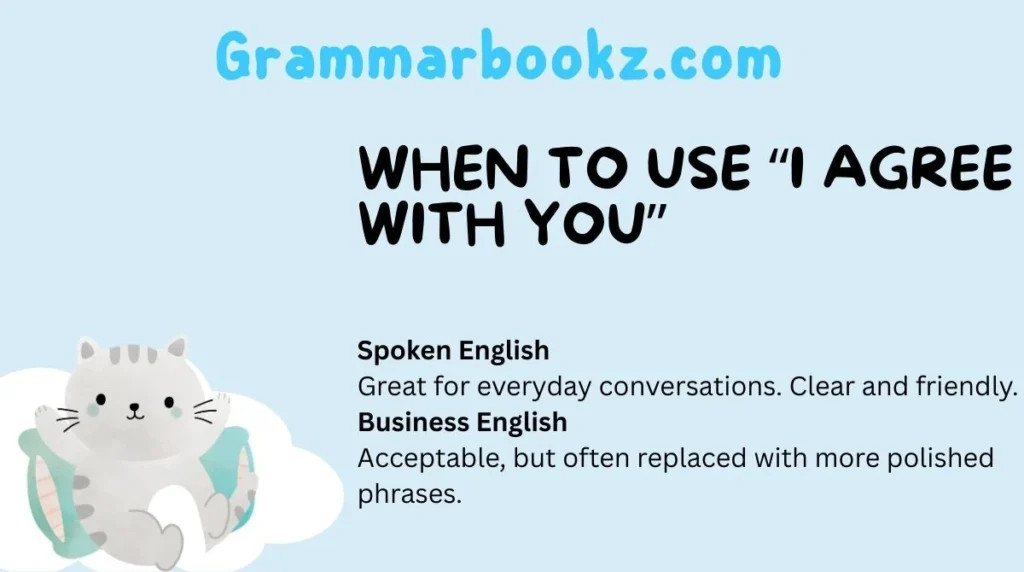
Spoken English
Great for everyday conversations. Clear and friendly.
Business English
Acceptable, but often replaced with more polished phrases.
Emails / Messages
Fine in casual emails. In formal emails, alternatives sound better.
Social Media
Works, but short phrases like “Exactly” or “Well said” feel more natural.
Academic Writing
Usually avoided. Academic tone prefers phrases like “This view is valid.”
Professional Meetings
Safe, but stronger agreement phrases show confidence.
Is “I Agree With You” Polite or Professional?
The phrase is neutral and polite.
- Polite: Yes
- Professional: Yes, but basic
- Strong: No
- Soft: Yes
- Formal: Medium
- Informal: Medium
Etiquette tip:
Use it in conversation. In corporate emails or presentations, choose a more formal alternative to sound confident and senior.
Pros & Cons of Using “I Agree With You”
✔ Pros
- Easy to understand
- Safe in most situations
- Good for beginners
✘ Cons
- Repetitive
- Sounds weak in professional settings
- Lacks emotion or emphasis
Quick Alternatives List (For Fast Use)
- You’re right
- Exactly
- I completely agree
- That’s true
- I’m on the same page
- I feel the same way
- Well said
- Absolutely
- I couldn’t agree more
- That makes sense
- I support this
- I share your view
- I’m in agreement
- That’s a valid point
- I think so too
- Agreed
- Fair point
- No doubt
- I stand by that
- I back this
- You’ve got a point
- That’s spot on
- I align with this
- I see it the same way
- This is correct
Absolutely
Meaning:
A strong yes.
Explanation:
Shows full and confident agreement. Very common in spoken English and meetings.
Grammar note:
Adverb used as a response.
Example sentence:
“Absolutely. That approach will save time.”
Best use:
Meetings, emails, conversations.
Worst use:
Very formal academic writing.
Tone:
Strong, confident.
Level:
Beginner.
Similarity score:
9/10.
Replaceability tip:
Use when you want energy and clarity.
You’re Right
Meaning:
The other person is correct.
Explanation:
Direct and natural. Can sound supportive or slightly blunt depending on tone.
Grammar note:
Statement.
Example sentence:
“You’re right about the risks involved.”
Best use:
Conversation, feedback.
Worst use:
When correcting a superior publicly.
Tone:
Neutral to friendly.
Level:
Beginner.
Similarity score:
8/10.
Replaceability tip:
Use when confirming facts or logic.
I Completely Agree
Meaning:
Full agreement.
Explanation:
Stronger than “I agree with you.” Sounds confident and professional.
Grammar note:
Verb phrase.
Example sentence:
“I completely agree with your recommendation.”
Best use:
Emails, meetings.
Worst use:
Casual texting.
Tone:
Professional.
Level:
Beginner–Intermediate.
Similarity score:
10/10.
Replaceability tip:
Best direct upgrade of the original phrase.
Exactly
Meaning:
Yes, that is correct.
Explanation:
Short and natural. Often used as a reaction.
Grammar note:
Interjection.
Example sentence:
“Exactly! That’s the issue.”
Best use:
Spoken English, chats.
Worst use:
Formal writing.
Tone:
Casual.
Level:
Beginner.
Similarity score:
7/10.
Replaceability tip:
Use when responding quickly.
That’s True
Meaning:
The statement is correct.
Explanation:
Soft agreement. Often used before adding more thoughts.
Grammar note:
Statement.
Example sentence:
“That’s true, especially in large teams.”
Best use:
Discussion, reflection.
Worst use:
Strong persuasion moments.
Tone:
Neutral.
Level:
Beginner.
Similarity score:
7/10.
Replaceability tip:
Good when transitioning to another idea.
I’m on the Same Page
Meaning:
We think the same way.
Explanation:
Friendly and professional idiom. Common in workplaces.
Grammar note:
Idiom.
Example sentence:
“I’m on the same page regarding the timeline.”
Best use:
Workplace, meetings.
Worst use:
Academic essays.
Tone:
Professional-friendly.
Level:
Intermediate.
Similarity score:
8/10.
Replaceability tip:
Use for teamwork language.
I Couldn’t Agree More
Meaning:
Very strong agreement.
Explanation:
Expresses enthusiasm and full support.
Grammar note:
Idiomatic phrase.
Example sentence:
“I couldn’t agree more with that conclusion.”
Best use:
Speeches, emails.
Worst use:
Very casual chats.
Tone:
Strong, positive.
Level:
Intermediate.
Similarity score:
9/10.
Replaceability tip:
Use when passion matters.
Well Said
Meaning:
The idea was expressed clearly.
Explanation:
Agrees with both the idea and its expression.
Grammar note:
Past participle phrase.
Example sentence:
“Well said. That explains it clearly.”
Best use:
Social media, discussions.
Worst use:
Formal reports.
Tone:
Friendly.
Level:
Beginner.
Similarity score:
6/10.
Replaceability tip:
Use when praising delivery.
That Makes Sense
Meaning:
The idea is logical.
Explanation:
Agreement based on understanding, not emotion.
Grammar note:
Statement.
Example sentence:
“That makes sense given the data.”
Best use:
Workplace, learning.
Worst use:
Emotional discussions.
Tone:
Neutral.
Level:
Beginner.
Similarity score:
7/10.
Replaceability tip:
Good when logic is key.
I Share Your View
Meaning:
You have the same opinion.
Explanation:
Formal and polite. Common in writing.
Grammar note:
Verb phrase.
Example sentence:
“I share your view on this matter.”
Best use:
Formal emails, writing.
Worst use:
Casual speech.
Tone:
Formal.
Level:
Intermediate.
Similarity score:
9/10.
Replaceability tip:
Use in professional writing.
That’s a Valid Point
Meaning:
The argument is reasonable.
Explanation:
Often used even when partial agreement exists.
Grammar note:
Statement.
Example sentence:
“That’s a valid point about cost.”
Best use:
Meetings, debates.
Worst use:
Strong disagreement moments.
Tone:
Professional.
Level:
Intermediate.
Similarity score:
6/10.
Replaceability tip:
Use to show respect.
I’m in Agreement
Meaning:
Formal agreement.
Explanation:
Sounds official and structured.
Grammar note:
Formal phrase.
Example sentence:
“I’m in agreement with the proposal.”
Best use:
Documents, formal speech.
Worst use:
Casual talk.
Tone:
Formal.
Level:
Advanced.
Similarity score:
9/10.
Replaceability tip:
Use in official contexts.
Fair Point
Meaning:
The argument is reasonable.
Explanation:
Casual and thoughtful. Often used mid-discussion.
Grammar note:
Noun phrase.
Example sentence:
“Fair point. I hadn’t considered that.”
Best use:
Discussions.
Worst use:
Formal writing.
Tone:
Casual-neutral.
Level:
Intermediate.
Similarity score:
5/10.
Replaceability tip:
Good for debates.
I Support This
Meaning:
You agree and back the idea.
Explanation:
Shows active approval.
Grammar note:
Verb phrase.
Example sentence:
“I support this initiative.”
Best use:
Workplace, leadership.
Worst use:
Casual chat.
Tone:
Professional.
Level:
Intermediate.
Similarity score:
8/10.
Replaceability tip:
Use when action matters.
I Align With This
Meaning:
Your view matches another.
Explanation:
Corporate and strategic tone.
Grammar note:
Verb phrase.
Example sentence:
“I align with this strategy.”
Best use:
Corporate settings.
Worst use:
Daily conversation.
Tone:
Professional.
Level:
Advanced.
Similarity score:
8/10.
Replaceability tip:
Use in leadership talk.
Mini Dialogue Examples
Formal
A: “The data supports this approach.”
B: “I completely agree with your assessment.”
Informal
A: “This movie was amazing.”
B: “Absolutely!”
Business Email
“Thank you for your suggestion. I share your view and support this direction.”
Mistakes to Avoid
- Using slang in formal emails
- Sounding too strong with term
- Repeating one phrase too often
- Using casual phrases in academic writing
- Saying “Agree” alone in formal contexts
- Confusing partial agreement with full agreement
Cultural & Tone Tips
In US English, short responses like “Exactly” feel natural.
In UK English, softer phrases like “I think you’re right” sound polite.
In casual social English, tone matters more than words. Voice and context change meaning.
Comparison Table
| Phrase | Tone | Best Context | Professional Level | Example |
|---|---|---|---|---|
| I completely agree | Professional | Meetings | High | “I completely agree with this plan.” |
| Absolutely | Strong | Speech | Medium | “Absolutely, let’s proceed.” |
| I share your view | Formal | Emails | High | “I share your view on this.” |
| Exactly | Casual | Chat | Low | “Exactly!” |
| That’s a valid point | Neutral | Discussion | Medium | “That’s a valid point.” |
FAQs
Is “I agree with you” rude?
No. It is polite and safe.
Is it okay in emails?
Yes, but formal alternatives sound better.
What is the most formal alternative?
“I’m in agreement” or “I share your view.”
What is the most polite alternative?
“I completely agree” or “That’s a valid point.”
What should beginners use?
“You’re right” or “That’s true.”
Can I use “Absolutely” at work?
Yes, in meetings and friendly emails.
Conclusion
Learning other ways to say “I agree with you” helps your English sound richer and more natural.
The right phrase shows confidence, respect, and awareness of context. Whether you are writing emails, speaking in meetings, or chatting with friends, word choice shapes how people see you.
Practice these alternatives in real conversations. Start small. Switch one phrase at a time. Over time, your fluency and professionalism will grow naturally.

John Lee is an education-focused writer with a strong interest in English grammar and language learning.
He creates clear, student-friendly content to help learners improve their grammar skills with confidence.