“I agree with you” is one of the most common phrases in English conversations. It shows support, alignment, and understanding. But when you use it again and again, your speech or writing can sound flat or repetitive.
This matters more than people think. The words you choose affect your tone, your professionalism, and how confident you sound.
Using alternative expressions helps you sound natural and fluent. It also lets you match the situation better.
A casual chat with friends needs a different tone than a business meeting or an academic discussion. Small changes in wording can make a big difference.
Compare this:
- Formal: “I completely agree with your assessment.”
- Informal: “Yeah, I’m with you on that.”
Same meaning. Very different impact.
This guide will help you choose the right words at the right time.
What Does “I Agree With You” Mean?
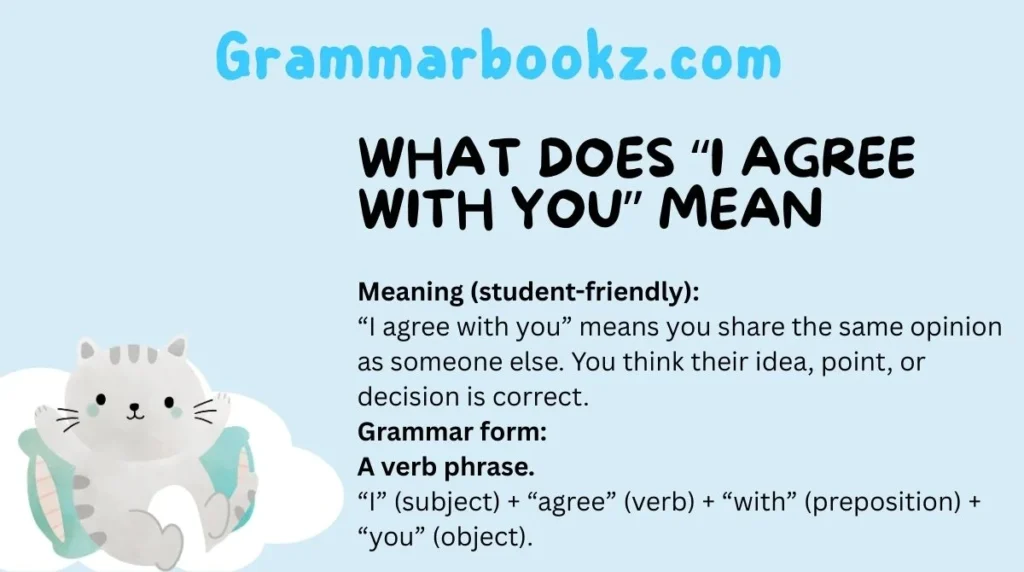
Meaning (student-friendly):
“I agree with you” means you share the same opinion as someone else. You think their idea, point, or decision is correct.
Grammar form:
A verb phrase.
“I” (subject) + “agree” (verb) + “with” (preposition) + “you” (object).
Similar expressions:
“I think the same.”
“That’s right.”
“You’re correct.”
Opposite tone expressions:
“I disagree.”
“I’m not sure about that.”
“I see it differently.”
Sample sentences:
“I agree with you about the deadline.”
“I agree with you. That plan makes sense.”
When to Use “I Agree With You”
Spoken English
Perfect for everyday conversations. It sounds clear and polite.
Business English
Acceptable, but often replaced with more professional phrases in meetings.
Emails / Messages
Fine in internal emails. In formal emails, alternatives sound smoother.
Social media
Very common and friendly. Often shortened or replaced with casual forms.
Academic writing
Rarely used. Formal agreement phrases are preferred.
Professional meetings
Okay, but stronger or more specific agreement sounds more confident.
Is “I Agree With You” Polite or Professional?
The phrase is polite and neutral. It is not rude. But it is also not very strong.
Tone levels:
- Polite: Yes
- Neutral: Yes
- Strong: No
- Soft: Yes
- Formal: Medium
- Informal: Medium
Etiquette tip:
Good for conversations and team talks. In corporate emails or presentations, choose a more polished alternative.
Pros & Cons of Using “I Agree With You”
✔ Pros:
- Clear and easy to understand
- Safe and polite
- Suitable for most situations
✘ Cons:
- Sounds basic if overused
- Not strong enough for leadership roles
- Too simple for academic or formal writing
Quick Alternatives List (For Busy Readers)
- I completely agree
- You’re absolutely right
- That makes sense
- I’m on the same page
- I share your view
- I couldn’t agree more
- I see it the same way
- That’s a valid point
- I support that idea
- I’m with you on this
- I agree entirely
- I concur
- That aligns with my thinking
- I second that
- I feel the same way
- Exactly
- True that
Strong and Natural Alternatives to “I Agree With You”
I Completely Agree
Meaning:
I agree 100%.
Explanation:
Adds strength and confidence. Shows full support.
Grammar Note:
Adverb + verb phrase.
Example Sentence:
“I completely agree with your approach.”
Best Use:
Workplace, meetings, emails.
Worst Use:
Very casual chats where it may sound serious.
Tone:
Professional, strong.
Level:
Beginner.
Similarity Score:
9/10
Replaceability Tip:
Use when you want to sound firm and confident.
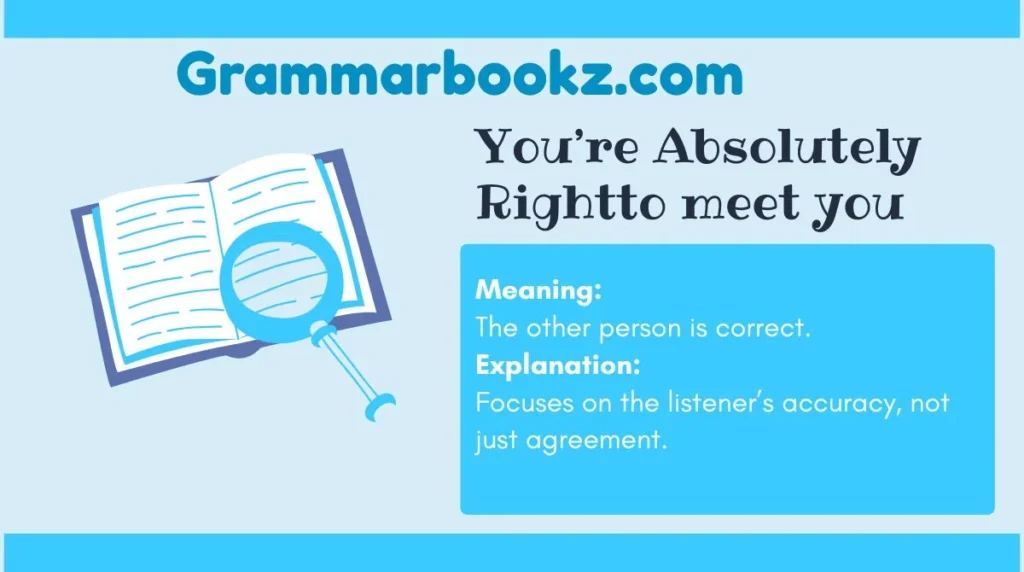
You’re Absolutely Right
Meaning:
The other person is correct.
Explanation:
Focuses on the listener’s accuracy, not just agreement.
Grammar Note:
Statement phrase.
Example Sentence:
“You’re absolutely right about the risks.”
Best Use:
Spoken English, meetings.
Worst Use:
Academic writing.
Tone:
Friendly, confident.
Level:
Beginner.
Similarity Score:
8/10
Replaceability Tip:
Use to encourage or validate someone.
I’m on the Same Page
Meaning:
We think the same way.
Explanation:
Common in teamwork and collaboration.
Grammar Note:
Idiom.
Example Sentence:
“I’m on the same page regarding the timeline.”
Best Use:
Workplace, meetings.
Worst Use:
Formal essays.
Tone:
Professional, friendly.
Level:
Intermediate.
Similarity Score:
7/10
Replaceability Tip:
Great for showing teamwork.
That Makes Sense
Meaning:
I understand and agree.
Explanation:
Softer agreement. Shows logical acceptance.
Grammar Note:
Clause.
Example Sentence:
“That makes sense given the data.”
Best Use:
Discussions, problem-solving.
Worst Use:
When strong support is needed.
Tone:
Neutral, soft.
Level:
Beginner.
Similarity Score:
6/10
Replaceability Tip:
Use when agreement comes from reasoning.
I Share Your View
Meaning:
I have the same opinion.
Explanation:
Sounds thoughtful and mature.
Grammar Note:
Formal verb phrase.
Example Sentence:
“I share your view on this matter.”
Best Use:
Emails, professional talks.
Worst Use:
Casual texting.
Tone:
Formal, professional.
Level:
Intermediate.
Similarity Score:
8/10
Replaceability Tip:
Good for polite professional agreement.
I Couldn’t Agree More
Meaning:
Very strong agreement.
Explanation:
Emotional and emphatic.
Grammar Note:
Idiomatic expression.
Example Sentence:
“I couldn’t agree more with your conclusion.”
Best Use:
Spoken English, presentations.
Worst Use:
Very formal writing.
Tone:
Strong, expressive.
Level:
Intermediate.
Similarity Score:
9/10
Replaceability Tip:
Use when passion is appropriate.
That’s a Valid Point
Meaning:
The idea is reasonable and correct.
Explanation:
Acknowledges logic and fairness.
Grammar Note:
Noun phrase.
Example Sentence:
“That’s a valid point about customer needs.”
Best Use:
Discussions, debates.
Worst Use:
Simple chats.
Tone:
Professional, respectful.
Level:
Intermediate.
Similarity Score:
7/10
Replaceability Tip:
Great when analyzing ideas.
I Concur
Meaning:
I agree.
Explanation:
Very formal and concise.
Grammar Note:
Formal verb.
Example Sentence:
“I concur with your recommendation.”
Best Use:
Legal, academic, formal business.
Worst Use:
Casual speech.
Tone:
Formal, serious.
Level:
Advanced.
Similarity Score:
8/10
Replaceability Tip:
Use in high-level professional settings.
Exactly
Meaning:
Yes, that is correct.
Explanation:
Short and strong reaction.
Grammar Note:
Interjection.
Example Sentence:
“Exactly. That’s what I meant.”
Best Use:
Spoken English.
Worst Use:
Formal writing.
Tone:
Strong, informal.
Level:
Beginner.
Similarity Score:
6/10
Replaceability Tip:
Use for quick agreement.
I’m With You on This
Meaning:
I support your idea.
Explanation:
Casual and friendly.
Grammar Note:
Idiomatic phrase.
Example Sentence:
“I’m with you on this decision.”
Best Use:
Team chats, casual talks.
Worst Use:
Formal emails.
Tone:
Friendly, informal.
Level:
Beginner.
Similarity Score:
7/10
Replaceability Tip:
Use to show support.
That Aligns With My Thinking
Meaning:
Your idea matches mine.
Explanation:
Sounds thoughtful and professional.
Grammar Note:
Formal phrase.
Example Sentence:
“That aligns with my thinking on the issue.”
Best Use:
Meetings, emails.
Worst Use:
Text messages.
Tone:
Professional.
Level:
Advanced.
Similarity Score:
8/10
Replaceability Tip:
Use in strategic discussions.
I Support That
Meaning:
I agree and back the idea.
Explanation:
Shows action-oriented agreement.
Grammar Note:
Verb phrase.
Example Sentence:
“I support that proposal.”
Best Use:
Workplace, leadership roles.
Worst Use:
Casual chats.
Tone:
Strong, professional.
Level:
Intermediate.
Similarity Score:
7/10
Replaceability Tip:
Use when decisions matter.
True
Meaning:
That is correct.
Explanation:
Very casual agreement.
Grammar Note:
Interjection.
Example Sentence:
“True, we need more data.”
Best Use:
Informal speech.
Worst Use:
Formal settings.
Tone:
Casual.
Level:
Beginner.
Similarity Score:
5/10
Replaceability Tip:
Use only in relaxed talk.
I Feel the Same Way
Meaning:
I have the same opinion.
Explanation:
Adds emotional connection.
Grammar Note:
Verb phrase.
Example Sentence:
“I feel the same way about the plan.”
Best Use:
Personal conversations.
Worst Use:
Formal writing.
Tone:
Soft, friendly.
Level:
Beginner.
Similarity Score:
7/10
Replaceability Tip:
Use when emotions matter.
I Second That
Meaning:
I formally agree.
Explanation:
Often used in meetings.
Grammar Note:
Formal expression.
Example Sentence:
“I second that motion.”
Best Use:
Meetings, votes.
Worst Use:
Casual chats.
Tone:
Formal.
Level:
Intermediate.
Similarity Score:
6/10
Replaceability Tip:
Use in structured discussions.
That’s Fair
Meaning:
The point is reasonable.
Explanation:
Soft agreement with balance.
Grammar Note:
Adjective phrase.
Example Sentence:
“That’s fair. We should reconsider.”
Best Use:
Negotiations.
Worst Use:
Academic writing.
Tone:
Neutral.
Level:
Beginner.
Similarity Score:
6/10
Replaceability Tip:
Use when compromise is needed.
I Agree Entirely
Meaning:
Full agreement.
Explanation:
Formal and complete.
Grammar Note:
Adverbial phrase.
Example Sentence:
“I agree entirely with your findings.”
Best Use:
Reports, emails.
Worst Use:
Casual speech.
Tone:
Formal.
Level:
Intermediate.
Similarity Score:
9/10
Replaceability Tip:
Use in written communication.
Mini Dialogue Examples
Formal Conversation
A: “The data supports a phased launch.”
B: “I agree entirely. The evidence is clear.”
Informal Conversation
A: “We should leave early.”
B: “Yeah, I’m with you on that.”
Business Email Style
“Thank you for your insights. I share your view on prioritizing customer feedback.”
Mistakes to Avoid
- Using casual phrases in formal emails
- Overusing one phrase repeatedly
- Saying “I am agree” instead of “I agree”
- Using slang in professional meetings
- Sounding too strong when politeness is needed
- Using very formal phrases in friendly chats
Cultural & Tone Tips
In US English, agreement is often direct and confident.
In UK English, softer phrases sound more polite.
In casual social English, short reactions like “Exactly” or “True” are common.
Tone matters more than grammar. Matching the setting is key.
Comparison Table of Useful Alternatives
| Phrase | Tone | Best Context | Professional Level | Example |
|---|---|---|---|---|
| I completely agree | Strong | Meetings | High | I completely agree with this plan. |
| You’re absolutely right | Friendly | Discussion | Medium | You’re absolutely right about costs. |
| I concur | Formal | Legal/Academic | Very High | I concur with the analysis. |
| That makes sense | Soft | Problem-solving | Medium | That makes sense logically. |
| I’m on the same page | Professional | Teamwork | High | We’re on the same page. |
FAQs
Is “I agree with you” rude?
No. It is polite and neutral.
Is it okay to use it in emails?
Yes, but formal alternatives sound better.
What is the most formal alternative?
“I concur” or “I agree entirely.”
What is the most polite alternative?
“I share your view.”
What should beginners use?
“I completely agree” or “That makes sense.”
Can I use casual phrases at work?
Only in relaxed or internal communication.
Conclusion
Using different ways to say “I agree with you” makes your English richer and clearer. It helps you sound confident, polite, and professional in every situation.
The right phrase can strengthen your message and improve how others see you. Practice these alternatives in real conversations, emails, and meetings.
Over time, choosing the right words will feel natural. Strong language leads to strong communication.

John Lee is an education-focused writer with a strong interest in English grammar and language learning.
He creates clear, student-friendly content to help learners improve their grammar skills with confidence.