
The phrase “I have completed the task” is clear, correct, and widely used. But using it again and again can sound stiff, repetitive, or even robotic.
In English, especially in professional and academic settings, how you say something often matters just as much as what you say. Word choice affects tone, confidence, and how others perceive your communication skills.
Learning alternative expressions helps you sound more natural, fluent, and adaptable. It allows you to match your language to the situation—formal emails, friendly chats, workplace updates, or academic writing.
Native speakers constantly switch phrases to fit context, and doing the same instantly upgrades your English.
Short contrast example:
Formal: “The assignment has been completed.”
Informal: “All done!”
Both mean the same thing, but the tone is very different.
What Does “I Have Completed the Task” Mean?
At its core, “I have completed the task” means that a piece of work, duty, or assignment is finished. Nothing more is required from the speaker at this stage.
Grammar-wise, this phrase uses the present perfect tense, which connects a past action to the present moment. It focuses on the result, not the process.
It functions as a verb phrase, often used in professional and academic communication.
Common synonyms include:
I’ve finished, I’m done, The work is complete
Opposite ideas include:
I’m still working on it, It’s not finished yet
Sample sentences:
I have completed the task you assigned yesterday.
Let me know if any revisions are needed.
When to Use “I Have Completed the Task”
In spoken English, it works best in formal or semi-formal conversations, such as talking to a teacher, manager, or client.
In business English, it is often used in reports, status updates, and performance reviews.
In emails and messages, it sounds professional but slightly stiff. Many writers prefer softer alternatives.
On social media, it sounds too formal and is rarely used.
In academic writing, it is acceptable when reporting research steps or assignments.
In professional meetings, it works when clarity is more important than tone.
Is “I Have Completed the Task” Polite or Professional?
This phrase is neutral to professional in tone. It is polite but not warm. It sounds factual and efficient.
It can feel:
- Polite but distant
- Clear but impersonal
- Professional but slightly rigid
Etiquette tip:
Good for reports and formal updates.
Avoid overusing it in friendly workplace emails where a softer tone builds better relationships.
Pros & Cons of Using “I Have Completed the Task”
✔ Pros:
- Clear and direct
- Grammatically correct
- Widely understood
- Professional and safe
✘ Cons:
- Sounds repetitive if overused
- Can feel cold or robotic
- Not flexible for casual settings
Quick Alternatives List (For Busy Readers)
- I’ve finished the task
- The task is complete
- I’m done with it
- I’ve wrapped it up
- The work has been finalized
- All set
- I’ve taken care of it
- The assignment is done
- I’ve completed everything
- It’s been handled
- Work is finished
- Task accomplished
- I’ve closed the task
- I’ve fulfilled the requirement
- Everything is complete
- Job done
Strong Alternatives You Can Use Naturally
I’ve finished the task
Meaning: The work is done.
Explanation: This is the most natural everyday replacement. It sounds fluent and human.
Grammar Note: Verb phrase, present perfect.
Example Sentence: I’ve finished the task and uploaded the file.
Best Use: Email, workplace, spoken English
Worst Use: Very formal reports
Tone: Neutral
Level: Beginner
Similarity Score: 9/10
Replaceability Tip: Use when you want to sound natural but still professional.
The task is complete
Meaning: The work is fully done.
Explanation: This shifts focus from the person to the result. It sounds formal and objective.
Grammar Note: Passive voice.
Example Sentence: The task is complete and ready for review.
Best Use: Reports, formal emails
Worst Use: Casual chats
Tone: Formal
Level: Intermediate
Similarity Score: 8/10
Replaceability Tip: Ideal when reporting status, not personal effort.
I’m done with it
Meaning: I have finished.
Explanation: Very casual and conversational. It sounds relaxed and friendly.
Grammar Note: Informal verb phrase.
Example Sentence: I’m done with it. Want me to start the next one?
Best Use: Spoken English, team chats
Worst Use: Corporate emails
Tone: Informal
Level: Beginner
Similarity Score: 7/10
Replaceability Tip: Use only with people you know well.
I’ve completed everything
Meaning: All assigned work is finished.
Explanation: Emphasizes that nothing is left unfinished.
Grammar Note: Present perfect verb phrase.
Example Sentence: I’ve completed everything you requested.
Best Use: Workplace updates
Worst Use: Academic writing
Tone: Professional
Level: Intermediate
Similarity Score: 9/10
Replaceability Tip: Good when handling multiple tasks.
The assignment is done
Meaning: The specific task is finished.
Explanation: Common in academic and training settings.
Grammar Note: Simple present passive.
Example Sentence: The assignment is done and submitted.
Best Use: School, training, emails
Worst Use: High-level corporate reports
Tone: Neutral
Level: Beginner
Similarity Score: 8/10
Replaceability Tip: Perfect for student communication.
I’ve wrapped it up
Meaning: I have finished the work.
Explanation: Friendly and slightly informal, often used in offices.
Grammar Note: Phrasal verb.
Example Sentence: I’ve wrapped it up ahead of schedule.
Best Use: Workplace, emails
Worst Use: Academic papers
Tone: Friendly
Level: Intermediate
Similarity Score: 7/10
Replaceability Tip: Use to sound positive and efficient.
The work has been finalized
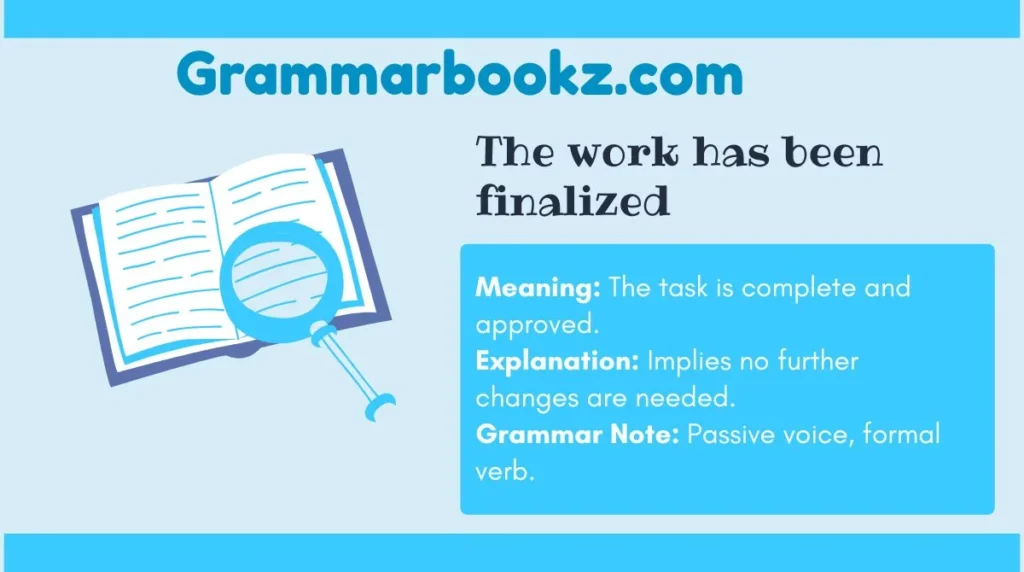
Meaning: The task is complete and approved.
Explanation: Implies no further changes are needed.
Grammar Note: Passive voice, formal verb.
Example Sentence: The work has been finalized and sent to the client.
Best Use: Business, legal, corporate
Worst Use: Casual conversation
Tone: Formal
Level: Advanced
Similarity Score: 8/10
Replaceability Tip: Use when completion is official.
I’ve taken care of it
Meaning: The task is handled.
Explanation: Suggests responsibility and reliability.
Grammar Note: Idiomatic verb phrase.
Example Sentence: Don’t worry—I’ve taken care of it.
Best Use: Workplace, spoken English
Worst Use: Formal documentation
Tone: Confident
Level: Intermediate
Similarity Score: 7/10
Replaceability Tip: Use to reassure someone.
All set
Meaning: Everything is finished.
Explanation: Very short and casual. Common in spoken English.
Grammar Note: Idiomatic expression.
Example Sentence: All set. Ready for the next step.
Best Use: Informal chats, spoken English
Worst Use: Reports, formal emails
Tone: Casual
Level: Beginner
Similarity Score: 6/10
Replaceability Tip: Use when brevity matters.
Task accomplished
Meaning: The goal has been achieved.
Explanation: Slightly dramatic but confident. Often used humorously.
Grammar Note: Fixed phrase.
Example Sentence: Task accomplished. Great teamwork.
Best Use: Informal workplace settings
Worst Use: Serious corporate writing
Tone: Strong
Level: Intermediate
Similarity Score: 6/10
Replaceability Tip: Use for emphasis or celebration.
The job is done
Meaning: The work is finished.
Explanation: Clear, direct, and widely understood.
Grammar Note: Simple present.
Example Sentence: The job is done. Let’s move on.
Best Use: Workplace, spoken English
Worst Use: Academic writing
Tone: Neutral
Level: Beginner
Similarity Score: 8/10
Replaceability Tip: Use when clarity is key.
I’ve fulfilled the requirement
Meaning: I have met what was expected.
Explanation: Sounds formal and precise. Often used in compliance or academics.
Grammar Note: Formal verb phrase.
Example Sentence: I’ve fulfilled the requirement for this project.
Best Use: Academic, legal, professional
Worst Use: Casual speech
Tone: Formal
Level: Advanced
Similarity Score: 8/10
Replaceability Tip: Use when expectations matter.
Everything is complete
Meaning: Nothing remains unfinished.
Explanation: Neutral and flexible.
Grammar Note: Simple present.
Example Sentence: Everything is complete and organized.
Best Use: Emails, spoken English
Worst Use: Very casual chats
Tone: Neutral
Level: Beginner
Similarity Score: 9/10
Replaceability Tip: Great general replacement.
I’ve closed the task
Meaning: The task is finished and recorded as complete.
Explanation: Common in project management systems.
Grammar Note: Verb phrase.
Example Sentence: I’ve closed the task in the system.
Best Use: Technical, corporate environments
Worst Use: Casual conversation
Tone: Professional
Level: Advanced
Similarity Score: 7/10
Replaceability Tip: Use in structured workflows.
The work is finished
Meaning: The task is done.
Explanation: Simple and neutral, slightly more formal than “I’m done.”
Grammar Note: Passive construction.
Example Sentence: The work is finished and ready.
Best Use: Emails, spoken English
Worst Use: Very casual settings
Tone: Neutral
Level: Beginner
Similarity Score: 9/10
Replaceability Tip: Safe for most contexts.
I’ve handled it
Meaning: I managed and completed the task.
Explanation: Emphasizes capability and control.
Grammar Note: Informal verb phrase.
Example Sentence: I’ve handled it, no issues.
Best Use: Workplace conversations
Worst Use: Academic writing
Tone: Confident
Level: Intermediate
Similarity Score: 7/10
Replaceability Tip: Use when responsibility matters.
Mini Dialogue Examples
Formal conversation:
Manager: Can you confirm the report status?
Employee: Yes, the work has been finalized.
Informal conversation:
Friend: Did you finish that thing?
You: Yeah, all set.
Business email style:
Hello Sarah,
I’ve completed everything discussed in our meeting. Please let me know if revisions are required.
Mistakes to Avoid
- Using casual phrases in formal emails
- Overusing one phrase repeatedly
- Mixing slang with professional language
- Forgetting tense consistency
- Sounding too blunt in polite contexts
- Using passive voice when clarity needs action
- Choosing tone without considering audience
Cultural & Tone Tips
In US English, shorter phrases like “All set” or “I’ve got it done” sound friendly and confident.
In UK English, speakers often prefer softer, understated phrases like “That’s been completed.”
In casual social English, tone matters more than grammar. Overly formal phrases can sound distant.
Comparison Table of Strong Choices
| Phrase | Tone | Best Context | Professional Level | Example |
|---|---|---|---|---|
| I’ve finished the task | Neutral | Medium | I’ve finished the task today. | |
| The task is complete | Formal | Reports | High | The task is complete. |
| All set | Casual | Spoken | Low | All set on my end. |
| I’ve wrapped it up | Friendly | Workplace | Medium | I’ve wrapped it up early. |
| The work has been finalized | Formal | Corporate | High | The work has been finalized. |
FAQs
Is “I have completed the task” rude?
No. It is neutral and professional, but slightly stiff.
Is it okay to use in emails?
Yes, especially formal emails. Softer options work better for friendly teams.
What is the most formal alternative?
The work has been finalized.
What is the most polite alternative?
I’ve completed everything you requested.
What should beginners use?
I’ve finished the task or The work is finished.
Can I use casual phrases at work?
Yes, but only in relaxed environments or team chats.
Conclusion
Knowing multiple ways to say “I have completed the task” gives you control over tone, clarity, and professionalism.
The right phrase helps you sound confident, natural, and culturally aware. Whether you’re writing emails, speaking in meetings, or chatting casually, variety improves fluency and leaves a better impression.
Practice using different expressions in real situations, and soon they will feel natural. Strong communication is not about using big words—it’s about using the right words.

John Lee is an education-focused writer with a strong interest in English grammar and language learning.
He creates clear, student-friendly content to help learners improve their grammar skills with confidence.