
The phrase “I will follow up with you” is common in English. You hear it in offices, emails, meetings, and even casual chats.
It means you will contact someone again later to give information, updates, or results. Simple. Useful. But also overused.
Using the same phrase again and again can sound dull, robotic, or even vague. Word choice matters. A small change can make you sound more polite, more confident, more professional, or more friendly.
This is especially important for English learners, professionals, and anyone writing emails or messages at work.
Strong alternatives help you match the situation.
Formal talk needs formal words.
Friendly chats need relaxed language.
Example contrast:
Formal: “I will get back to you shortly.”
Informal: “I’ll message you later.”
Learning these options improves clarity, tone, and fluency in real English.
Other Ways to Say “I Will Follow Up With You” in Email
In professional email communication, repeating the same phrase can feel monotonous, so using alternatives to “I will follow up with you” helps improve clarity and tone. You can say “I will get back to you shortly” to sound polite and timely, or “I’ll check in with you soon” for a friendly approach.
Phrases like “I will keep you updated,” “I’ll reconnect with you,” or “I will circle back with you” are also widely used in business emails. If you want to sound more formal, try “I will provide further updates soon” or “I will follow up shortly with more details.” Using these variations not only enhances your email writing skills but also makes your communication more engaging and professional.
What Does “I Will Follow Up With You” Mean?
Student-friendly meaning:
It means you will contact someone again later to continue a conversation or give more information.
Grammar form:
Verb phrase (phrasal verb: follow up)
Similar expressions:
Get back to you, check in with you, reach out again
Opposite tone ideas:
Drop the matter, leave it there, no further action
Sample sentences:
- I will follow up with you once I get the details.
- She said she would follow up after the meeting.
When to Use “I Will Follow Up With You”
Spoken English
Used when ending a conversation politely and clearly.
Business English
Very common in meetings, calls, and presentations.
Emails / Messages
Used to show responsibility and future action.
Social Media
Acceptable but sounds formal. Often shortened.
Academic Writing
Rarely used. Sounds too conversational.
Professional Meetings
Helpful when assigning tasks or next steps.
Is “I Will Follow Up With You” Polite or Professional?
Yes, it is polite and professional. But tone depends on context.
- Polite: Shows care and responsibility
- Neutral: Standard workplace phrase
- Strong: Clear promise of action
- Soft: Can sound vague if not specific
- Formal: Accepted in business writing
- Informal: Slightly stiff for friends
Etiquette tip:
Good for the workplace. Avoid overusing it in corporate emails without details.
Pros & Cons of Using “I Will Follow Up With You”
✔ Pros:
- Clear and safe
- Widely understood
- Professional tone
- Works in most industries
✘ Cons:
- Overused
- Can sound vague
- Less natural in casual speech
- Weak without time frame
Quick Alternatives List (For Busy Readers)
- I’ll get back to you
- I’ll check in with you
- I’ll reach out again
- I’ll keep you updated
- I’ll let you know
- I’ll contact you shortly
- I’ll circle back
- I’ll follow up shortly
- I’ll update you soon
- I’ll be in touch
- I’ll message you later
- I’ll connect with you
- I’ll send you an update
- I’ll confirm with you
I’ll Get Back to You
Meaning:
I will reply later.
Explanation:
This is one of the most natural alternatives. It sounds polite, confident, and clear. Very common in spoken and written English.
Grammar Note:
Phrasal verb
Example Sentence:
I’ll get back to you once I hear from the team.
Best Use:
Email, workplace, meetings
Worst Use:
Very formal legal writing
Tone:
Professional, neutral
Level:
Beginner
Similarity Score:
9/10
Replaceability Tip:
Use this when you want to sound natural and clear.
I’ll Be in Touch
Meaning:
I will contact you again.
Explanation:
This phrase is polite and slightly formal. It sounds smooth and confident.
Grammar Note:
Idiomatic expression
Example Sentence:
Thanks for your time. I’ll be in touch soon.
Best Use:
Emails, interviews, networking
Worst Use:
Casual texting with friends
Tone:
Professional, polite
Level:
Beginner
Similarity Score:
8/10
Replaceability Tip:
Perfect for ending emails professionally.
I’ll Let You Know
Meaning:
I will inform you later.
Explanation:
Simple and friendly. It focuses on sharing information, not action.
Grammar Note:
Verb phrase
Example Sentence:
I’ll let you know once the date is confirmed.
Best Use:
Texts, casual emails, work chats
Worst Use:
Formal reports
Tone:
Friendly, neutral
Level:
Beginner
Similarity Score:
7/10
Replaceability Tip:
Good when information is the main goal.
I’ll Check In With You
Meaning:
I will contact you to see how things are going.
Explanation:
This sounds caring and polite. Often used when progress or well-being matters.
Grammar Note:
Phrasal verb
Example Sentence:
I’ll check in with you next week.
Best Use:
Workplace, coaching, teamwork
Worst Use:
Urgent matters
Tone:
Soft, friendly
Level:
Intermediate
Similarity Score:
7/10
Replaceability Tip:
Use when follow-up is supportive, not urgent.
I’ll Reach Out Again
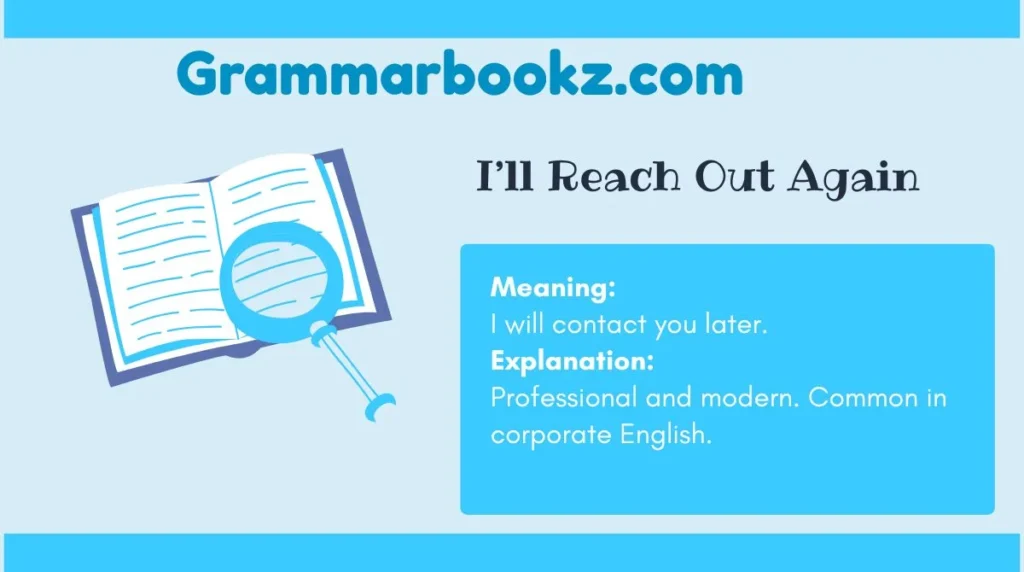
Meaning:
I will contact you later.
Explanation:
Professional and modern. Common in corporate English.
Grammar Note:
Phrasal verb
Example Sentence:
I’ll reach out again after reviewing your request.
Best Use:
Business emails, LinkedIn messages
Worst Use:
Very casual talk
Tone:
Professional
Level:
Intermediate
Similarity Score:
8/10
Replaceability Tip:
Great for formal digital communication.
I’ll Keep You Updated
Meaning:
I will give you regular information.
Explanation:
This shows responsibility and ongoing communication.
Grammar Note:
Verb phrase
Example Sentence:
I’ll keep you updated on the progress.
Best Use:
Projects, teamwork, management
Worst Use:
One-time updates
Tone:
Professional, strong
Level:
Intermediate
Similarity Score:
6/10
Replaceability Tip:
Use when updates will happen more than once.
I’ll Get in Touch With You
Meaning:
I will contact you later.
Explanation:
Similar to “be in touch” but slightly more direct.
Grammar Note:
Phrasal verb
Example Sentence:
I’ll get in touch with you tomorrow.
Best Use:
Emails, calls
Worst Use:
Casual slang chats
Tone:
Professional, polite
Level:
Beginner
Similarity Score:
8/10
Replaceability Tip:
Good when you know the time frame.
I’ll Message You Later
Meaning:
I will send a message later.
Explanation:
Casual and clear. Not suitable for formal settings.
Grammar Note:
Verb phrase
Example Sentence:
I’ll message you later today.
Best Use:
Texts, casual work chats
Worst Use:
Formal emails
Tone:
Informal, friendly
Level:
Beginner
Similarity Score:
6/10
Replaceability Tip:
Use in relaxed communication.
I’ll Send You an Update
Meaning:
I will share new information.
Explanation:
Clear and professional. Focuses on content.
Grammar Note:
Verb phrase
Example Sentence:
I’ll send you an update by Friday.
Best Use:
Emails, reports
Worst Use:
Spoken casual chat
Tone:
Professional
Level:
Intermediate
Similarity Score:
7/10
Replaceability Tip:
Best when written communication is planned.
I’ll Confirm With You
Meaning:
I will verify and inform you.
Explanation:
Strong and clear. Shows accuracy.
Grammar Note:
Verb phrase
Example Sentence:
I’ll confirm with you once it’s approved.
Best Use:
Formal emails, scheduling
Worst Use:
Casual talk
Tone:
Professional, strong
Level:
Intermediate
Similarity Score:
7/10
Replaceability Tip:
Use when certainty matters.
I’ll Contact You Shortly
Meaning:
I will contact you very soon.
Explanation:
Formal and time-focused.
Grammar Note:
Formal phrase
Example Sentence:
I’ll contact you shortly with the details.
Best Use:
Customer service, business emails
Worst Use:
Casual messages
Tone:
Formal
Level:
Advanced
Similarity Score:
8/10
Replaceability Tip:
Good when speed is important.
I’ll Circle Back
Meaning:
I will return to this topic later.
Explanation:
Popular in corporate English. Sounds modern.
Grammar Note:
Idiomatic business phrase
Example Sentence:
Let’s circle back on this next week.
Best Use:
Meetings, office talk
Worst Use:
Academic writing
Tone:
Professional, casual-business
Level:
Advanced
Similarity Score:
6/10
Replaceability Tip:
Use in modern office culture.
I’ll Follow Up Shortly
Meaning:
I will contact you again soon.
Explanation:
A clearer version of the original phrase.
Grammar Note:
Verb phrase
Example Sentence:
I’ll follow up shortly with more info.
Best Use:
Emails, work messages
Worst Use:
Casual texting
Tone:
Professional
Level:
Beginner
Similarity Score:
10/10
Replaceability Tip:
Use when you want clarity without change.
I’ll Connect With You
Meaning:
I will contact or communicate with you.
Explanation:
Professional and flexible.
Grammar Note:
Verb phrase
Example Sentence:
I’ll connect with you after the call.
Best Use:
Networking, business
Worst Use:
Very casual chats
Tone:
Professional, neutral
Level:
Intermediate
Similarity Score:
7/10
Replaceability Tip:
Great for networking contexts.
Mini Dialogue Examples
Formal
Manager: Thank you for the update.
Employee: I’ll get back to you with the final numbers.
Informal
Friend: Any news yet?
You: Not yet, but I’ll message you later.
Business Email Style
Thank you for your inquiry. I’ll send you an update by tomorrow.
Mistakes to Avoid
- Using it without a time frame
- Using formal phrases in casual chats
- Overusing the same phrase
- Mixing slang with formal emails
- Forgetting subject-verb agreement
- Sounding vague or unclear
Cultural & Tone Tips
US English:
Direct and clear alternatives are preferred.
UK English:
Softer phrases sound more polite.
Casual Social English:
Short and friendly expressions feel natural.
Native speakers care about tone more than grammar perfection.
Comparison Table
| Phrase | Tone | Best Context | Professional Level | Example |
|---|---|---|---|---|
| I’ll get back to you | Neutral | Medium | I’ll get back to you soon | |
| I’ll be in touch | Polite | Networking | High | I’ll be in touch shortly |
| I’ll let you know | Friendly | Casual work | Low | I’ll let you know |
| I’ll circle back | Business-casual | Meetings | Medium | Let’s circle back |
| I’ll contact you shortly | Formal | Customer service | High | I’ll contact you shortly |
FAQs
Is “I will follow up with you” rude?
No. It is polite and professional.
Is it okay in emails?
Yes, very common in business emails.
What is the most formal alternative?
“I’ll contact you shortly.”
What is the most polite alternative?
“I’ll be in touch.”
What should beginners use?
“I’ll get back to you.”
Is “I’ll circle back” informal?
It is business-casual, not formal.
Conclusion
Using only one phrase limits your English. Learning alternatives to “I will follow up with you” helps you sound clearer, more confident, and more natural.
Different situations need different tones. Formal emails need precision. Casual chats need warmth. By choosing the right expression, you improve communication and professionalism.
Practice these phrases in real conversations. The more you use them, the more fluent and confident you will feel.

John Lee is an education-focused writer with a strong interest in English grammar and language learning.
He creates clear, student-friendly content to help learners improve their grammar skills with confidence.