The phrase “I would be happy to” is polite, positive, and widely used in English. It shows willingness and a friendly attitude.
But when you use it again and again, your language can sound repetitive or flat—especially in emails, meetings, or professional writing. Choosing the right alternative helps you control tone, clarity, and professional impact.
Word choice matters. In business, it can show confidence. In emails, it can sound warm without being casual. In daily conversation, it can feel natural and relaxed.
Using varied expressions also makes your English sound fluent and human.
Quick contrast:
- Formal: “I would be happy to assist with your request.”
- Informal: “Sure, I can help with that.”
This guide gives you strong, natural alternatives for every situation—formal, informal, and professional.
What Does “I Would Be Happy To” Mean?
Student-friendly definition:
“I would be happy to” means you are willing and pleased to do something for someone.
Grammar form:
Verb phrase (modal + adjective + infinitive)
Similar meanings:
- I’m glad to
- I’m willing to
- I’d be pleased to
Opposite tones:
- I’d rather not
- I’m not available to
- I can’t help with that
Examples:
- “I would be happy to answer your questions.”
- “I’d be happy to help if you need anything.”
When to Use “I Would Be Happy To”
Spoken English
Great for polite conversations, especially with new people.
Business English
Common in customer service, meetings, and professional offers.
Emails / Messages
Works well in formal and semi-formal emails.
Social Media
Sounds a bit formal, but okay for brand replies.
Academic Writing
Rarely used; sounds personal rather than academic.
Professional Meetings
Polite and safe when offering help or support.
Is “I Would Be Happy To” Polite or Professional?
This phrase is both polite and professional, but also soft.
Tone levels:
- Polite: Yes
- Neutral: Sometimes
- Strong: No
- Soft: Yes
- Formal: Medium
- Informal: No
Etiquette tip:
Perfect for workplace emails. Avoid overusing it in short chats where a simple “Sure” works better.
Pros & Cons of Using “I Would Be Happy To”
✔ Pros:
- Polite and friendly
- Safe in professional settings
- Easy for learners
✘ Cons:
- Can sound repetitive
- Sometimes too soft
- Less confident in leadership roles
Quick Alternatives List
- I’d be glad to
- I’d be pleased to
- I’m happy to help
- I’d love to
- I’m willing to
- I can help with that
- I’d be more than happy to
- I’d be delighted to
- I’m available to
- I’d be open to
- I’m ready to
- I’m keen to
- I’d be happy to assist
- I’d welcome the opportunity to
- Count on me to
- Sure, no problem
Expanded Alternatives
I’d Be Glad To
Meaning: Willing and pleased.
Explanation: Slightly warmer than the original. Sounds natural and polite.
Grammar Note: Verb phrase.
Example Sentence: “I’d be glad to review the document.”
Best Use: Email, workplace.
Worst Use: Casual texting.
Tone: Professional, friendly.
Level: Beginner.
Similarity Score: 9/10.
Replaceability Tip: Use when you want a polite but lighter tone.
I’d Be Pleased To
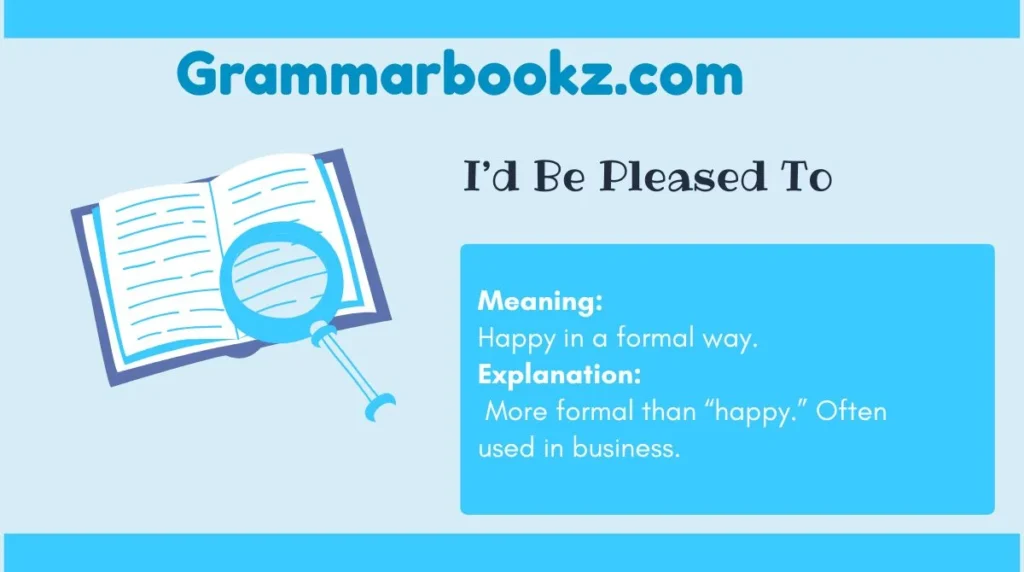
Meaning: Happy in a formal way.
Explanation: More formal than “happy.” Often used in business.
Grammar Note: Formal phrase.
Example Sentence: “I’d be pleased to discuss this further.”
Best Use: Business, emails.
Worst Use: Social media.
Tone: Formal, professional.
Level: Intermediate.
Similarity Score: 9/10.
Replaceability Tip: Choose this for corporate communication.
I’m Happy to Help
Meaning: Willing to assist.
Explanation: Friendly and supportive.
Grammar Note: Verb phrase.
Example Sentence: “I’m happy to help if you need guidance.”
Best Use: Customer service, emails.
Worst Use: Legal writing.
Tone: Friendly, professional.
Level: Beginner.
Similarity Score: 8/10.
Replaceability Tip: Use when offering support directly.
I’d Love To
Meaning: Very willing and excited.
Explanation: Shows enthusiasm. Informal and warm.
Grammar Note: Informal phrase.
Example Sentence: “I’d love to join the project.”
Best Use: Casual talk, friendly emails.
Worst Use: Formal reports.
Tone: Friendly, informal.
Level: Beginner.
Similarity Score: 7/10.
Replaceability Tip: Use to show excitement.
I’m Willing To
Meaning: Ready to do something.
Explanation: Neutral and practical. Less emotional.
Grammar Note: Verb phrase.
Example Sentence: “I’m willing to adjust the schedule.”
Best Use: Negotiations.
Worst Use: Emotional situations.
Tone: Neutral.
Level: Intermediate.
Similarity Score: 6/10.
Replaceability Tip: Use when discussing conditions.
I Can Help With That
Meaning: Offering assistance.
Explanation: Direct and confident.
Grammar Note: Modal verb phrase.
Example Sentence: “I can help with that today.”
Best Use: Spoken English.
Worst Use: Very formal emails.
Tone: Neutral, confident.
Level: Beginner.
Similarity Score: 6/10.
Replaceability Tip: Use in quick replies.
I’d Be More Than Happy To
Meaning: Very pleased.
Explanation: Stronger enthusiasm.
Grammar Note: Emphatic phrase.
Example Sentence: “I’d be more than happy to assist.”
Best Use: Polite emails.
Worst Use: Short messages.
Tone: Polite, warm.
Level: Intermediate.
Similarity Score: 8/10.
Replaceability Tip: Use when extra warmth is needed.
I’d Be Delighted To
Meaning: Extremely pleased.
Explanation: Formal and elegant.
Grammar Note: Formal phrase.
Example Sentence: “I’d be delighted to attend.”
Best Use: Invitations, formal replies.
Worst Use: Casual chats.
Tone: Formal, positive.
Level: Advanced.
Similarity Score: 8/10.
Replaceability Tip: Use for high-level politeness.
I’m Available To
Meaning: Free to do something.
Explanation: Practical and time-focused.
Grammar Note: Verb phrase.
Example Sentence: “I’m available to meet tomorrow.”
Best Use: Scheduling.
Worst Use: Emotional offers.
Tone: Neutral, professional.
Level: Beginner.
Similarity Score: 5/10.
Replaceability Tip: Use when time matters.
I’d Be Open To
Meaning: Willing to consider.
Explanation: Flexible and thoughtful.
Grammar Note: Idiomatic phrase.
Example Sentence: “I’d be open to new ideas.”
Best Use: Discussions.
Worst Use: Clear commitments.
Tone: Neutral.
Level: Intermediate.
Similarity Score: 5/10.
Replaceability Tip: Use when not fully committed.
I’m Ready To
Meaning: Prepared to act.
Explanation: Strong and confident.
Grammar Note: Verb phrase.
Example Sentence: “I’m ready to begin.”
Best Use: Leadership roles.
Worst Use: Polite refusals.
Tone: Strong.
Level: Beginner.
Similarity Score: 4/10.
Replaceability Tip: Use to show confidence.
I’m Keen To
Meaning: Interested and willing.
Explanation: Common in UK English.
Grammar Note: Informal phrase.
Example Sentence: “I’m keen to learn more.”
Best Use: UK contexts.
Worst Use: US formal emails.
Tone: Friendly.
Level: Intermediate.
Similarity Score: 6/10.
Replaceability Tip: Use in British English.
I’d Be Happy to Assist
Meaning: Formal help offer.
Explanation: Professional customer-service tone.
Grammar Note: Formal phrase.
Example Sentence: “I’d be happy to assist you.”
Best Use: Business emails.
Worst Use: Casual talk.
Tone: Professional.
Level: Beginner.
Similarity Score: 9/10.
Replaceability Tip: Use instead of “help.”
I’d Welcome the Opportunity To
Meaning: Positive and formal interest.
Explanation: Shows respect and interest.
Grammar Note: Formal phrase.
Example Sentence: “I’d welcome the opportunity to collaborate.”
Best Use: Job applications.
Worst Use: Text messages.
Tone: Formal.
Level: Advanced.
Similarity Score: 7/10.
Replaceability Tip: Use in professional growth contexts.
Count on Me To
Meaning: Strong willingness.
Explanation: Confident and supportive.
Grammar Note: Idiom.
Example Sentence: “Count on me to deliver.”
Best Use: Team settings.
Worst Use: Formal writing.
Tone: Strong, friendly.
Level: Intermediate.
Similarity Score: 5/10.
Replaceability Tip: Use to show reliability.
Sure, No Problem
Meaning: Casual agreement.
Explanation: Very informal and relaxed.
Grammar Note: Spoken phrase.
Example Sentence: “Sure, no problem—I’ll do it.”
Best Use: Friends, chats.
Worst Use: Corporate emails.
Tone: Informal.
Level: Beginner.
Similarity Score: 4/10.
Replaceability Tip: Use only in casual contexts.
Mini Dialogue Examples
Formal:
A: “Could you review the report?”
B: “I’d be pleased to.”
Informal:
A: “Can you help me later?”
B: “Sure, no problem.”
Business Email:
“Thank you for your message. I’d be happy to assist with your request.”
Mistakes to Avoid
- Overusing one phrase
- Using informal phrases in formal emails
- Sounding too soft in leadership roles
- Mixing tones in one message
- Using “love” in serious contexts
- Forgetting cultural tone differences
Cultural & Tone Tips
US English: Direct and friendly. “I’m happy to help” works well.
UK English: Slightly softer. “I’d be keen to” sounds natural.
Casual Social English: Short phrases like “Sure” feel best.
Comparison Table
| Phrase | Tone | Best Context | Professional Level | Example |
|---|---|---|---|---|
| I’d be glad to | Friendly | Emails | Medium | “I’d be glad to assist.” |
| I’d be pleased to | Formal | Business | High | “I’d be pleased to discuss.” |
| I’d love to | Informal | Social | Low | “I’d love to join.” |
| I’m available to | Neutral | Scheduling | Medium | “I’m available tomorrow.” |
| I’d welcome the opportunity to | Formal | Jobs | High | “I’d welcome the opportunity.” |
FAQs
Is “I would be happy to” rude?
No. It is polite and friendly.
Is it okay in emails?
Yes. It’s common in professional emails.
What is the most formal alternative?
“I’d be pleased to” or “I’d welcome the opportunity to.”
What is the most polite alternative?
“I’d be delighted to.”
What should beginners use?
“I’m happy to help.”
Can I use it in academic writing?
Usually no. It sounds personal.
Conclusion
Using alternatives to “I would be happy to” helps you sound fluent, confident, and natural. Different situations need different tones.
A friendly chat needs simple words. A business email needs polish. When you vary your language, your message becomes clearer and more professional.
Practice these expressions in real conversations and writing. Over time, your English will feel smoother, stronger, and more confident.

John Lee is an education-focused writer with a strong interest in English grammar and language learning.
He creates clear, student-friendly content to help learners improve their grammar skills with confidence.