
The phrase “in case you are not aware” is commonly used in English to introduce information the speaker believes the listener may not know.
It often appears in emails, meetings, explanations, and workplace conversations. While useful, repeating this phrase too often can sound stiff, passive-aggressive, or overly formal—especially in professional settings.
Learning alternative expressions helps you sound more natural, polite, and confident. Word choice shapes tone. It can make you sound respectful or rude, helpful or arrogant.
In business, emails, essays, and daily conversation, varied language improves clarity and shows strong communication skills.
Compare:
- Formal: In case you are not aware, the deadline has changed.
- Friendly: Just so you know, the deadline has changed.
Same idea. Different feeling. That difference matters.
What Does “In Case You Are Not Aware” Mean?
Student-friendly meaning:
It is used to politely tell someone information they may not know yet.
Grammar form:
Introductory phrase (formal explanatory expression)
Common synonyms:
- Just so you know
- For your information
- If you didn’t know
Opposite tone expressions:
- As you already know (assumes awareness)
Example sentences:
- In case you are not aware, the office will be closed tomorrow.
- In case you are not aware, this policy has been updated.
When to Use “In Case You Are Not Aware”
Spoken English
Useful in careful, polite explanations, but can sound stiff in casual talk.
Business English
Common in meetings, presentations, and formal discussions.
Emails / Messages
Acceptable, but often replaced with softer options.
Social Media
Rarely used. Sounds too formal.
Academic Writing
Can be used, but usually replaced with “it should be noted that.”
Professional Meetings
Works well when sharing critical information respectfully.
Is “In Case You Are Not Aware” Polite or Professional?
This phrase is polite but sensitive. It can sound respectful—or slightly condescending—depending on tone.
- Polite: When used gently with helpful intent
- Neutral: In written announcements
- Strong: Can imply the listener should already know
- Soft: When paired with friendly language
Formal vs Informal:
It leans formal.
Etiquette tip:
Better for reports and official notices. Avoid in casual corporate emails where tone matters.
Pros & Cons of Using “In Case You Are Not Aware”
✔ Pros:
- Polite and respectful
- Clear and direct
- Professional tone
✘ Cons:
- Sounds stiff
- Can feel passive-aggressive
- Overused in emails
Quick Alternatives List (For Busy Readers)
- Just so you know
- For your information
- Please note that
- You may not be aware that
- As a reminder
- I wanted to let you know
- Kindly be informed
- It’s worth noting that
- In case it helps
- You should be aware that
- Allow me to clarify
- FYI
- Heads up
13 Strong Alternatives to “In Case You Are Not Aware”
Just so you know
Meaning:
Used to share information casually.
Explanation:
Friendly and natural. Common in spoken English.
Grammar Note:
Informal phrase
Example Sentence:
Just so you know, the meeting starts earlier today.
Best Use:
Text messages, casual emails
Worst Use:
Legal or academic writing
Tone:
Friendly
Level:
Beginner
Similarity Score:
9/10
Replaceability Tip:
Use when you want to sound helpful, not formal.
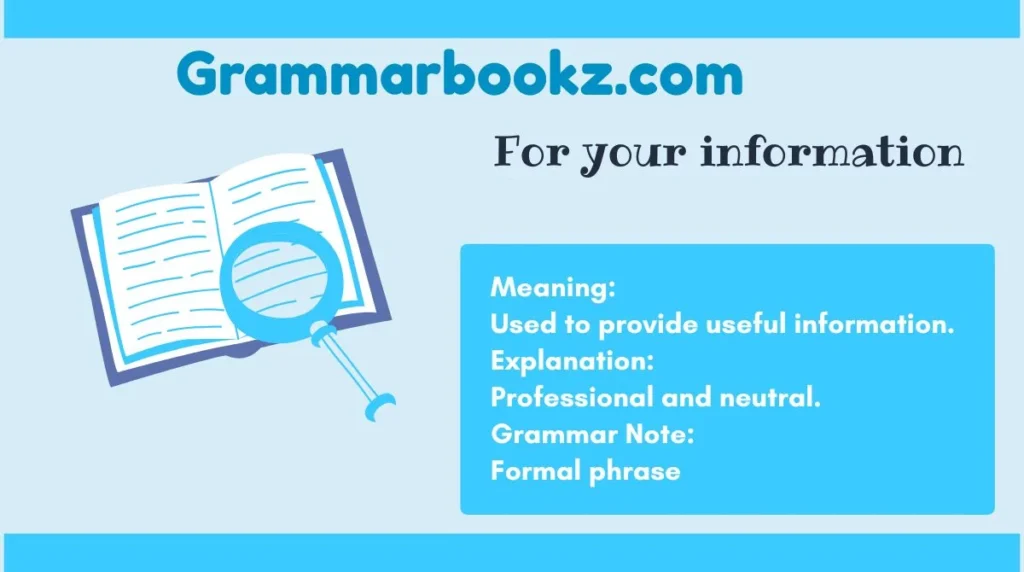
For your information
Meaning:
Used to provide useful information.
Explanation:
Professional and neutral.
Grammar Note:
Formal phrase
Example Sentence:
For your information, the policy has been revised.
Best Use:
Emails, workplace
Worst Use:
Friendly chats
Tone:
Professional
Level:
Intermediate
Similarity Score:
8/10
Replaceability Tip:
Best when sharing official facts.
Please note that
Meaning:
Asks attention to important details.
Explanation:
Polite and widely accepted in business.
Grammar Note:
Formal instruction phrase
Example Sentence:
Please note that payments are due Friday.
Best Use:
Professional emails
Worst Use:
Casual speech
Tone:
Formal
Level:
Intermediate
Similarity Score:
7/10
Replaceability Tip:
Great for instructions or reminders.
As a reminder
Meaning:
Refers to previously shared information.
Explanation:
Softens repetition.
Grammar Note:
Formal phrase
Example Sentence:
As a reminder, the deadline is approaching.
Best Use:
Workplace follow-ups
Worst Use:
First-time announcements
Tone:
Neutral
Level:
Intermediate
Similarity Score:
6/10
Replaceability Tip:
Use when repeating known information.
You may not be aware that
Meaning:
Acknowledges possible lack of knowledge.
Explanation:
Gentler than the original phrase.
Grammar Note:
Formal clause
Example Sentence:
You may not be aware that the schedule changed.
Best Use:
Professional conversation
Worst Use:
Very casual talk
Tone:
Soft professional
Level:
Advanced
Similarity Score:
9/10
Replaceability Tip:
Best when you want to sound respectful.
I wanted to let you know
Meaning:
Personal way to share information.
Explanation:
Warm and natural.
Grammar Note:
Verb phrase
Example Sentence:
I wanted to let you know the file is ready.
Best Use:
Emails, spoken English
Worst Use:
Legal documents
Tone:
Friendly-professional
Level:
Beginner
Similarity Score:
8/10
Replaceability Tip:
Use for human connection.
It’s worth noting that
Meaning:
Highlights important information.
Explanation:
Common in reports and presentations.
Grammar Note:
Formal expression
Example Sentence:
It’s worth noting that results may vary.
Best Use:
Academic, business
Worst Use:
Casual chats
Tone:
Formal
Level:
Advanced
Similarity Score:
7/10
Replaceability Tip:
Use when emphasizing significance.
Kindly be informed
Meaning:
Polite official notice.
Explanation:
Very formal. Common in international business.
Grammar Note:
Formal passive structure
Example Sentence:
Kindly be informed that the office is closed.
Best Use:
Official notices
Worst Use:
Friendly emails
Tone:
Very formal
Level:
Advanced
Similarity Score:
6/10
Replaceability Tip:
Use sparingly.
Heads up
Meaning:
Casual warning or notice.
Explanation:
Friendly and informal.
Grammar Note:
Slang phrase
Example Sentence:
Heads up—the meeting is canceled.
Best Use:
Text, casual teams
Worst Use:
Formal writing
Tone:
Casual
Level:
Beginner
Similarity Score:
7/10
Replaceability Tip:
Great for quick alerts.
FYI
Meaning:
Short form of “for your information.”
Explanation:
Efficient but informal.
Grammar Note:
Acronym
Example Sentence:
FYI, the link has changed.
Best Use:
Internal emails
Worst Use:
External formal emails
Tone:
Neutral-casual
Level:
Beginner
Similarity Score:
8/10
Replaceability Tip:
Avoid with clients unless culture allows.
Allow me to clarify
Meaning:
Introduces explanation.
Explanation:
Confident and polite.
Grammar Note:
Formal verb phrase
Example Sentence:
Allow me to clarify the process.
Best Use:
Meetings, presentations
Worst Use:
Casual talk
Tone:
Professional
Level:
Advanced
Similarity Score:
6/10
Replaceability Tip:
Use when correcting misunderstandings.
In case it helps
Meaning:
Soft way to share info.
Explanation:
Non-pushy and polite.
Grammar Note:
Conditional phrase
Example Sentence:
In case it helps, here’s the document.
Best Use:
Emails, teamwork
Worst Use:
Formal reports
Tone:
Soft
Level:
Intermediate
Similarity Score:
7/10
Replaceability Tip:
Use to sound cooperative.
You should be aware that
Meaning:
Direct notice of important info.
Explanation:
Stronger tone. Use carefully.
Grammar Note:
Modal verb phrase
Example Sentence:
You should be aware that changes are coming.
Best Use:
Serious discussions
Worst Use:
Friendly chats
Tone:
Strong-professional
Level:
Advanced
Similarity Score:
9/10
Replaceability Tip:
Best for critical points.
Mini Dialogue
Formal Conversation
A: You may not be aware that the policy was updated.
B: Thank you for informing me.
Informal Conversation
A: Just so you know, the plan changed.
B: Oh, thanks!
Business Email Style
Please note that the deadline has been extended.
Mistakes to Avoid (Common Learner Errors)
- Using formal phrases in casual chats
- Sounding passive-aggressive unintentionally
- Overusing one expression
- Using slang in academic writing
- Using “FYI” with senior management
- Forgetting tone differences
- Translating directly from native language
Cultural & Tone Tips
In US English, softer phrases like “just so you know” feel friendly.
In UK English, indirect wording sounds more polite.
In casual social English, short phrases are preferred.
Native speakers care deeply about tone. Choose carefully.
Comparison Table of Top Alternatives
| Phrase | Tone | Best Context | Professional Level | Example |
|---|---|---|---|---|
| Just so you know | Friendly | Casual | Low | Just so you know, I emailed them |
| For your information | Neutral | Emails | Medium | For your information, this changed |
| Please note that | Formal | Business | High | Please note that times vary |
| FYI | Casual | Internal | Low | FYI, it’s done |
| You may not be aware that | Polite | Meetings | High | You may not be aware that… |
| As a reminder | Neutral | Follow-ups | Medium | As a reminder, deadline Friday |
FAQs
Is “in case you are not aware” rude?
Not rude, but can sound stiff.
Is it okay in emails?
Yes, but softer options are better.
What is the most formal alternative?
“Kindly be informed.”
What is the most polite alternative?
“You may not be aware that.”
What should beginners use?
“Just so you know.”
Can I use it with my boss?
Yes, but choose a softer version.
Conclusion
Choosing the right words changes how people hear you. While “in case you are not aware” is correct, using alternatives helps you sound natural, confident, and professional.
Different situations need different tones. Business emails, casual chats, and academic writing all require care.
By learning and practicing these alternatives, you improve fluency and clarity. Try using one new phrase each day. Real improvement comes from real use.

John Lee is an education-focused writer with a strong interest in English grammar and language learning.
He creates clear, student-friendly content to help learners improve their grammar skills with confidence.