
The phrase “looking forward to being part of the team” is warm, positive, and widely used—especially in job interviews, onboarding emails, and professional introductions.
It shows excitement, openness, and readiness to collaborate. But when everyone uses the same line, it can start to feel repetitive or generic.
That’s where alternatives matter. Choosing the right expression helps you control tone, sound more natural, and match the situation—whether you’re writing a formal email, chatting with colleagues, or speaking in an interview.
Word choice shapes how confident, professional, or friendly you appear.
For example,
Formal: “I’m eager to contribute to the organization’s success.”
Informal: “Excited to work with everyone!”
Learning varied expressions improves clarity, fluency, and confidence across business, academic, and everyday English.
What Does “Looking Forward to Being Part of the Team” Mean?
Simple definition:
It means you are happy and excited about joining a group and working together with others.
Grammar form:
Verb phrase (present participle: looking forward to + noun/gerund)
Similar ideas:
Excited to join, eager to collaborate, happy to be involved
Opposite tone:
Reluctant to join, unsure about working together
Sample sentences:
- “I’m looking forward to being part of the team and learning from everyone.”
- “She said she’s looking forward to being part of the team next month.”
When to Use This Phrase
Spoken English
Used in interviews, introductions, or meetings to sound positive and cooperative.
Business English
Common in onboarding messages, HR communication, and professional greetings.
Emails / Messages
Works well at the end of acceptance emails or welcome replies.
Social Media
Often used on LinkedIn posts announcing a new role.
Academic Writing
Generally avoided; sounds too personal and informal.
Professional Meetings
Suitable when introducing yourself to a new group.
Is This Phrase Polite or Professional?
The phrase is polite, friendly, and neutral-professional.
Tone levels:
- Polite: Yes
- Neutral: Yes
- Strong: No
- Soft: Yes
- Formal vs Informal: Semi-formal
Etiquette tip:
Perfect for workplace introductions and emails, but avoid it in highly formal documents or executive-level communication.
Pros & Cons of Using the Phrase
✔ Pros:
- Friendly and positive
- Easy for learners
- Widely understood
- Safe in most workplaces
✘ Cons:
- Overused
- Can sound generic
- Not strong enough for senior roles
Quick Alternatives List (For Busy Readers)
- Excited to join the team
- Eager to collaborate with everyone
- Happy to be joining the group
- Keen to contribute to the team
- Thrilled to be on board
- Glad to work alongside you
- Ready to be part of the team
- Delighted to join the organization
- Looking ahead to working together
- Enthusiastic about joining
- Pleased to become part of the team
- Motivated to contribute
- Honored to join the team
- Excited to work with you all
- Keen to get started with the team
- Happy to be part of this journey
- Looking forward to collaborating
Excited to Join the Team
Meaning:
Feeling happy and eager about joining.
Explanation:
This is simple, energetic, and modern. It sounds natural and confident without being too formal.
Grammar Note:
Adjective phrase
Example Sentence:
“I’m excited to join the team and get started.”
Best Use:
Email, workplace, LinkedIn
Worst Use:
Academic writing
Tone:
Friendly, positive
Level:
Beginner
Similarity Score:
9/10
Replaceability Tip:
Use when you want a more energetic tone than the original.
Eager to Collaborate with the Team
Meaning:
Strong interest in working together.
Explanation:
This highlights teamwork and contribution rather than emotion.
Grammar Note:
Adjective + infinitive
Example Sentence:
“I’m eager to collaborate with the team on upcoming projects.”
Best Use:
Professional emails, meetings
Worst Use:
Casual text messages
Tone:
Professional, strong
Level:
Intermediate
Similarity Score:
8/10
Replaceability Tip:
Choose this when teamwork is the main focus.
Delighted to Join the Organization
Meaning:
Very pleased to become part of a company.
Explanation:
More formal and polished. Common in official communication.
Grammar Note:
Adjective phrase
Example Sentence:
“I’m delighted to join the organization and contribute.”
Best Use:
Formal emails, corporate settings
Worst Use:
Casual chats
Tone:
Formal, polite
Level:
Intermediate
Similarity Score:
7/10
Replaceability Tip:
Use for formal acceptance emails.
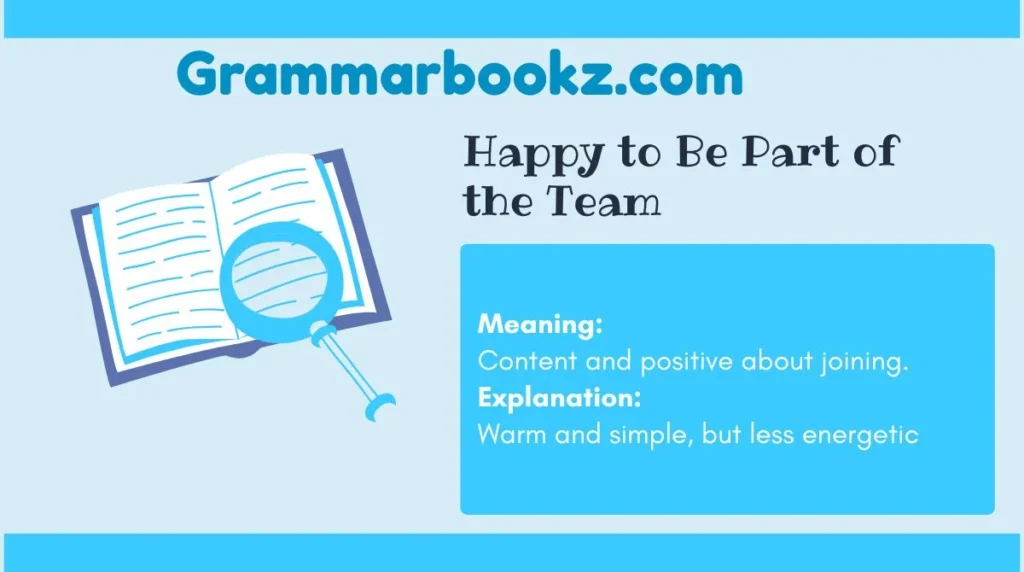
Happy to Be Part of the Team
Meaning:
Content and positive about joining.
Explanation:
Warm and simple, but less energetic.
Grammar Note:
Adjective phrase
Example Sentence:
“I’m happy to be part of the team.”
Best Use:
Daily workplace talk
Worst Use:
High-impact professional writing
Tone:
Soft, friendly
Level:
Beginner
Similarity Score:
10/10
Replaceability Tip:
Best for relaxed environments.
Thrilled to Be On Board
Meaning:
Very excited to join.
Explanation:
Enthusiastic and modern, common in startups.
Grammar Note:
Idiomatic phrase
Example Sentence:
“I’m thrilled to be on board with such a great team.”
Best Use:
Social media, casual emails
Worst Use:
Very formal contexts
Tone:
Strong, friendly
Level:
Intermediate
Similarity Score:
8/10
Replaceability Tip:
Use when excitement matters.
Keen to Contribute to the Team
Meaning:
Ready and motivated to help.
Explanation:
Focuses on action and value.
Grammar Note:
Adjective + infinitive
Example Sentence:
“I’m keen to contribute to the team’s success.”
Best Use:
Professional emails
Worst Use:
Casual texting
Tone:
Professional
Level:
Intermediate
Similarity Score:
7/10
Replaceability Tip:
Great when you want to show value.
Honored to Join the Team
Meaning:
Feeling proud and respectful.
Explanation:
Shows humility and respect.
Grammar Note:
Adjective phrase
Example Sentence:
“I’m honored to join the team.”
Best Use:
Formal, senior roles
Worst Use:
Very casual settings
Tone:
Formal, respectful
Level:
Advanced
Similarity Score:
6/10
Replaceability Tip:
Use when respect is key.
Looking Ahead to Working Together
Meaning:
Positive anticipation of collaboration.
Explanation:
Neutral and professional.
Grammar Note:
Verb phrase
Example Sentence:
“Looking ahead to working together.”
Best Use:
Emails, meetings
Worst Use:
Casual chats
Tone:
Neutral
Level:
Intermediate
Similarity Score:
7/10
Motivated to Be Part of the Team
Meaning:
Driven to join and contribute.
Explanation:
Shows internal motivation.
Grammar Note:
Adjective phrase
Example Sentence:
“I’m motivated to be part of the team.”
Best Use:
Interviews
Worst Use:
Social media
Tone:
Strong, professional
Level:
Advanced
Similarity Score:
6/10
Glad to Work with Everyone
Meaning:
Happy about collaboration.
Explanation:
Casual and friendly.
Grammar Note:
Adjective phrase
Example Sentence:
“I’m glad to work with everyone.”
Best Use:
Team chats
Worst Use:
Formal writing
Tone:
Friendly
Level:
Beginner
Similarity Score:
8/10
Pleased to Become Part of the Team
Meaning:
Satisfied and positive.
Explanation:
Polite and professional.
Grammar Note:
Adjective phrase
Example Sentence:
“I’m pleased to become part of the team.”
Best Use:
Formal emails
Worst Use:
Texts
Tone:
Polite, formal
Level:
Intermediate
Similarity Score:
9/10
Excited to Work Alongside You
Meaning:
Happy to collaborate with colleagues.
Explanation:
Personal and warm.
Grammar Note:
Adjective + infinitive
Example Sentence:
“I’m excited to work alongside you.”
Best Use:
Emails, meetings
Worst Use:
Academic writing
Tone:
Friendly-professional
Level:
Beginner
Similarity Score:
8/10
Happy to Join the Journey
Meaning:
Positive about the shared process.
Explanation:
Metaphorical and modern.
Grammar Note:
Idiomatic phrase
Example Sentence:
“Happy to join the journey with this team.”
Best Use:
Startups, social posts
Worst Use:
Corporate documents
Tone:
Friendly
Level:
Intermediate
Similarity Score:
6/10
Ready to Be Part of the Team
Meaning:
Prepared and willing.
Explanation:
Shows readiness rather than excitement.
Grammar Note:
Adjective phrase
Example Sentence:
“I’m ready to be part of the team.”
Best Use:
Interviews
Worst Use:
Celebratory messages
Tone:
Neutral
Level:
Beginner
Similarity Score:
9/10
Enthusiastic About Joining
Meaning:
Very interested and excited.
Explanation:
Balanced and professional.
Grammar Note:
Adjective + preposition
Example Sentence:
“I’m enthusiastic about joining the team.”
Best Use:
Emails, interviews
Worst Use:
Very casual texts
Tone:
Professional
Level:
Intermediate
Similarity Score:
9/10
Looking Forward to Collaborating
Meaning:
Anticipating teamwork.
Explanation:
Professional and action-focused.
Grammar Note:
Verb phrase
Example Sentence:
“Looking forward to collaborating with you all.”
Best Use:
Business communication
Worst Use:
Academic writing
Tone:
Professional
Level:
Intermediate
Similarity Score:
8/10
Mini Dialogue Examples
Formal
Manager: “Welcome aboard.”
Employee: “Thank you. I’m delighted to join the organization.”
Informal
Colleague: “Glad you’re here!”
You: “Excited to join the team!”
Business Email
“Thank you for the opportunity. I’m eager to collaborate with the team and contribute.”
Mistakes to Avoid
- Using overly casual phrases in formal emails
- Repeating the same phrase too often
- Mixing slang with professional language
- Using the phrase in academic writing
- Sounding too emotional in corporate settings
- Forgetting to match tone with context
Cultural & Tone Tips
In US English, enthusiasm is welcomed.
In UK English, softer and more reserved phrases sound better.
In casual social English, friendly and short expressions feel natural.
Comparison Table
| Phrase | Tone | Best Context | Professional Level | Example |
|---|---|---|---|---|
| Excited to join the team | Friendly | Medium | “I’m excited to join the team.” | |
| Delighted to join | Formal | Corporate | High | “Delighted to join the organization.” |
| Keen to contribute | Professional | Interviews | High | “Keen to contribute.” |
| Thrilled to be on board | Energetic | Social | Medium | “Thrilled to be on board!” |
| Happy to be part | Soft | Workplace | Low | “Happy to be part of the team.” |
FAQs
Is “looking forward to being part of the team” rude?
No. It’s polite and positive.
Is it okay in emails?
Yes, especially in professional emails.
What is the most formal alternative?
“Delighted to join the organization.”
What is the most polite option?
“Pleased to become part of the team.”
What should beginners use?
“Happy to be part of the team.”
Can I use it on LinkedIn?
Yes, it’s very common there.
Conclusion
Using different ways to say “looking forward to being part of the team” helps you sound more confident, natural, and professional.
Each alternative carries its own tone—some are formal, some friendly, and others action-focused. By choosing the right expression for the right situation, you improve clarity and build stronger connections.
Practice using these phrases in emails, conversations, and interviews. Over time, your English will feel smoother, richer, and more natural.

John Lee is an education-focused writer with a strong interest in English grammar and language learning.
He creates clear, student-friendly content to help learners improve their grammar skills with confidence.