The phrase “looking forward to seeing you” is one of the most common and friendly ways to express anticipation and positive expectation.
English learners, professionals, and native speakers all use it in emails, conversations, and messages. But because it is so common, it can sometimes feel repetitive, vague, or too casual for certain situations.
Choosing the right alternative matters. Word choice affects tone, professionalism, and clarity. In business emails, the wrong phrase can sound too informal. In personal messages, a formal phrase can feel cold.
Using varied language helps you sound confident, natural, and fluent in daily conversation, workplace communication, essays, and professional writing.
Example contrast:
Formal: I look forward to our meeting tomorrow.
Informal: Can’t wait to see you!
This guide will help you choose the right phrase for every situation.
What Does “Looking Forward to Seeing You” Mean?
Student-friendly meaning:
It means you feel happy, excited, or positive about meeting someone in the future.
Grammar form:
Verb phrase (present participle)
Similar meanings:
- Anticipating your visit
- Excited to meet you
- Eager to see you
Opposite tone phrases:
- Dreading the meeting
- Not excited about meeting
Example sentences:
- I’m looking forward to seeing you next week.
- We’re looking forward to seeing you at the event.
When to Use “Looking Forward to Seeing You”
Spoken English
Used naturally in daily conversation with friends, family, or colleagues.
Business English
Common in polite workplace speech, meetings, and presentations.
Emails / Messages
Often used at the end of emails to sound warm and cooperative.
Social Media
Works well in casual posts or replies.
Academic Writing
Rarely used. Academic tone prefers more formal phrasing.
Professional Meetings
Acceptable, but sometimes replaced with more formal alternatives.
Is “Looking Forward to Seeing You” Polite or Professional?
This phrase is generally polite and friendly. Its tone depends on context.
Polite: Yes
Neutral: Yes
Strong: No
Soft: Yes
Formal vs Informal:
- Semi-formal
- Friendly professional
Etiquette tip:
Good for emails and meetings. Avoid in very formal corporate or legal writing.
Pros & Cons of Using “Looking Forward to Seeing You”
✔ Pros:
- Friendly and positive
- Easy to understand
- Natural for most situations
- Safe for emails and conversation
✘ Cons:
- Overused
- Can sound vague
- Too casual for formal documents
- Lacks emotional strength in some contexts
Quick Alternatives List (For Busy Readers)
- I look forward to meeting you
- I look forward to seeing you soon
- I’m excited to see you
- I eagerly await our meeting
- I’m happy to see you soon
- Can’t wait to see you
- I anticipate our meeting
- I’ll be glad to see you
- I’m pleased to be meeting you
- I’m looking ahead to our meeting
- I’m eager to see you
- I await our meeting
- Excited for our meeting
- I’m glad we’ll meet soon
- I’m happy about our upcoming meeting
- I’m keen to see you
- I’m delighted to meet you
- See you soon
- Until we meet
- I welcome our upcoming meeting
- I’m thankful for the opportunity to meet
Main Alternatives Explained
I Look Forward to Meeting You
Meaning:
You expect to meet someone with positive feelings.
Explanation:
More formal than “seeing you.” Often used in business or first meetings.
Grammar Note:
Formal verb phrase
Example Sentence:
I look forward to meeting you next Monday.
Best Use:
Email, workplace, professional meetings
Worst Use:
Very casual chats
Tone:
Professional
Level:
Beginner
Similarity Score:
9/10
Replaceability Tip:
Use when meeting someone for the first time.
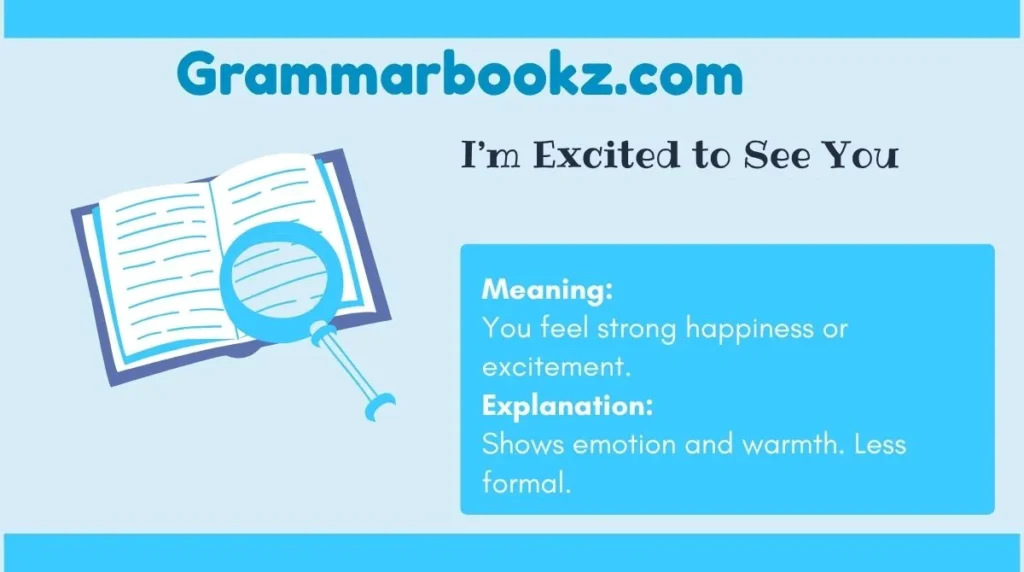
I’m Excited to See You
Meaning:
You feel strong happiness or excitement.
Explanation:
Shows emotion and warmth. Less formal.
Grammar Note:
Informal verb phrase
Example Sentence:
I’m excited to see you after so long.
Best Use:
Friends, family, texts
Worst Use:
Formal business emails
Tone:
Friendly
Level:
Beginner
Similarity Score:
8/10
Replaceability Tip:
Use when emotions matter more than formality.
I Eagerly Await Our Meeting
Meaning:
You strongly anticipate a meeting.
Explanation:
Very formal. Sounds polite and respectful.
Grammar Note:
Formal expression
Example Sentence:
I eagerly await our meeting next week.
Best Use:
Business, professional emails
Worst Use:
Casual conversation
Tone:
Formal
Level:
Advanced
Similarity Score:
7/10
Replaceability Tip:
Best for professional or international communication.
Can’t Wait to See You
Meaning:
You are very excited.
Explanation:
Extremely informal and emotional.
Grammar Note:
Colloquial phrase
Example Sentence:
Can’t wait to see you tonight!
Best Use:
Texts, social media
Worst Use:
Professional writing
Tone:
Casual
Level:
Beginner
Similarity Score:
8/10
Replaceability Tip:
Use only with people you know well.
I Anticipate Our Meeting
Meaning:
You expect the meeting positively.
Explanation:
Neutral and professional. Less emotional.
Grammar Note:
Formal verb
Example Sentence:
I anticipate our meeting on Thursday.
Best Use:
Business, reports
Worst Use:
Personal messages
Tone:
Neutral-professional
Level:
Intermediate
Similarity Score:
6/10
Replaceability Tip:
Use when you want a calm, professional tone.
I’m Delighted to Meet You
Meaning:
You feel pleased and honored.
Explanation:
Polite and slightly formal.
Grammar Note:
Formal phrase
Example Sentence:
I’m delighted to meet you in person.
Best Use:
First meetings, formal emails
Worst Use:
Casual texting
Tone:
Polite
Level:
Intermediate
Similarity Score:
7/10
Replaceability Tip:
Great for respectful introductions.
See You Soon
Meaning:
You will meet shortly.
Explanation:
Short, friendly, informal.
Grammar Note:
Informal phrase
Example Sentence:
See you soon!
Best Use:
Texts, spoken English
Worst Use:
Formal emails
Tone:
Casual
Level:
Beginner
Similarity Score:
6/10
Replaceability Tip:
Use when time is short and tone is friendly.
I’m Pleased to Be Meeting You
Meaning:
You feel polite satisfaction.
Explanation:
Formal and professional.
Grammar Note:
Formal continuous structure
Example Sentence:
I’m pleased to be meeting you tomorrow.
Best Use:
Business, interviews
Worst Use:
Informal chats
Tone:
Professional
Level:
Advanced
Similarity Score:
7/10
Replaceability Tip:
Best for polite workplace communication.
I’m Happy to See You Soon
Meaning:
You feel calm happiness.
Explanation:
Friendly but not emotional.
Grammar Note:
Neutral verb phrase
Example Sentence:
I’m happy to see you soon.
Best Use:
Emails, casual work talk
Worst Use:
Legal writing
Tone:
Neutral
Level:
Beginner
Similarity Score:
8/10
Replaceability Tip:
Safe option for most situations.
I’m Keen to See You
Meaning:
You are interested and positive.
Explanation:
Common in UK English.
Grammar Note:
Informal-professional phrase
Example Sentence:
I’m keen to see you next week.
Best Use:
UK workplace
Worst Use:
Very formal US emails
Tone:
Professional-friendly
Level:
Intermediate
Similarity Score:
7/10
Replaceability Tip:
Works well in British English.
Mini Dialogue Examples
Formal Conversation
A: Thank you for arranging the meeting.
B: I look forward to meeting you tomorrow.
Informal Conversation
A: I’ll be there at 7.
B: Great! Can’t wait to see you.
Business Email Style
Dear Ms. Lee,
Thank you for your time. I eagerly await our meeting next week.
Kind regards,
Mistakes to Avoid
- Using informal phrases in formal emails
- Overusing one phrase repeatedly
- Mixing emotional and professional tones
- Using slang in academic writing
- Forgetting context and audience
- Sounding too cold or too excited
- Copying phrases without understanding meaning
Cultural & Tone Tips
In US English, the phrase is friendly and common in emails.
In UK English, alternatives like keen to see you sound natural.
In casual social English, shorter phrases feel warmer and more natural.
Tone matters more than grammar. Native speakers judge feeling first.
Comparison Table
| Phrase | Tone | Best Context | Professional Level | Example |
|---|---|---|---|---|
| I look forward to meeting you | Formal | Business email | High | I look forward to meeting you tomorrow |
| Can’t wait to see you | Casual | Texts | Low | Can’t wait to see you! |
| I eagerly await our meeting | Very formal | Corporate | Very high | I eagerly await our meeting |
| I’m happy to see you soon | Neutral | Medium | I’m happy to see you soon | |
| I’m delighted to meet you | Polite | First meeting | High | I’m delighted to meet you |
FAQs
Is “looking forward to seeing you” rude?
No. It is polite and friendly.
Is it okay in emails?
Yes, especially in semi-formal emails.
What is the most formal alternative?
I eagerly await our meeting.
What is the most polite alternative?
I’m delighted to meet you.
What should beginners use?
I look forward to meeting you.
Can I use it in academic writing?
Usually no. Academic writing prefers neutral phrasing.
Conclusion
Using different ways to say “looking forward to seeing you” helps you sound more fluent, confident, and natural. The right phrase improves clarity, shows respect, and matches the situation.
Whether you are writing an email, speaking at work, or chatting with friends, word choice matters. Practice these alternatives in real conversations and writing.
Over time, your English will sound smoother, stronger, and more professional.

John Lee is an education-focused writer with a strong interest in English grammar and language learning.
He creates clear, student-friendly content to help learners improve their grammar skills with confidence.