The phrase “my name is” is one of the first English expressions people learn. It is simple, clear, and correct. But English does not stop there.
Native speakers rarely repeat the same phrase again and again, especially in professional, academic, or social settings.
Using alternative expressions helps you sound more natural, confident, and fluent.
In emails, meetings, interviews, or even casual chats, word choice affects tone. It can make you sound polite, friendly, formal, or relaxed.
For example:
Formal: “My name is Sarah Khan.”
More professional: “I’m Sarah Khan, the project coordinator.”
Both are correct. But one carries more context and confidence. This article will teach English learners and professionals how to introduce themselves clearly, politely, and appropriately—without always relying on the same basic phrase.
What Does “My Name Is” Mean?
“My name is” is a basic self-introduction phrase used to tell others what they should call you.
Grammar form:
A declarative phrase using the verb “to be.”
Tone:
Neutral and safe
Neither too formal nor too casual
Similar expressions:
“I’m called…”
“I go by…”
Opposite tone (less direct):
“You can call me…”
Example sentences:
- “My name is Daniel, and I’ll be your guide today.”
- “Hi, my name is Ayesha. Nice to meet you.”
When to Use “My Name Is”
Spoken English
Perfect for first meetings, classrooms, interviews, and introductions.
Business English
Acceptable, but often replaced by smoother professional alternatives.
Emails / Messages
Common in first-contact emails, especially formal ones.
Social Media
Used in bios, introductions, and posts, though often shortened.
Academic Writing
Rarely used. Academic writing avoids personal introductions.
Professional Meetings
Used, but many professionals prefer role-based introductions.
Is “My Name Is” Polite or Professional?
Yes, it is polite and neutral. However, it can sound basic or repetitive in professional settings.
Tone levels:
- Polite: ✔ Yes
- Neutral: ✔ Yes
- Strong: ✘ No
- Soft: ✔ Yes
- Formal: ✔ Acceptable
- Informal: ✔ Common
Etiquette tip:
Good for classrooms and casual meetings.
In corporate emails or presentations, alternatives sound more polished.
Pros & Cons of Using “My Name Is”
✔ Pros:
- Easy to understand
- Grammatically safe
- Beginner-friendly
- Universally accepted
✘ Cons:
- Sounds repetitive
- Lacks professional nuance
- Can feel flat in business settings
Quick Alternatives List
- I’m
- I am called
- You can call me
- I go by
- This is
- The name’s
- Allow me to introduce myself
- My full name is
- I’m known as
- I represent
- Speaking is
- This is [Name] speaking
- I’d like to introduce myself as
- My name would be
- People call me
- I answer to
- It’s
- I’m known professionally as
- I’d like to present myself as
- I’m pleased to introduce myself
- My given name is
- I prefer to be called
- I’m referred to as
- Let me introduce myself
- This is [Name]
25 Natural Alternatives to “My Name Is”
I’m
Meaning: A short form of “I am.”
Explanation: The most common and natural alternative.
Grammar Note: Verb contraction.
Example Sentence: “I’m Alex. Nice to meet you.”
Best Use: Informal, spoken English.
Worst Use: Very formal writing.
Tone: Friendly
Level: Beginner
Similarity Score: 10/10
Replaceability Tip: Use in daily conversation.
I am
Meaning: Full form of “I’m.”
Explanation: Slightly more formal than “I’m.”
Grammar Note: Verb phrase.
Example Sentence: “I am Maria Lopez from HR.”
Best Use: Presentations, introductions.
Worst Use: Casual texting.
Tone: Neutral
Level: Beginner
Similarity Score: 9/10
Replaceability Tip: Use when clarity matters.
You can call me
Meaning: Tells others what name to use.
Explanation: Friendly and polite.
Grammar Note: Modal verb phrase.
Example Sentence: “You can call me Sam.”
Best Use: Casual and semi-formal settings.
Worst Use: Legal documents.
Tone: Soft
Level: Beginner
Similarity Score: 8/10
Replaceability Tip: Great when offering a nickname.
I go by
Meaning: The name you usually use.
Explanation: Suggests preference.
Grammar Note: Phrasal verb.
Example Sentence: “I go by Mike at work.”
Best Use: Informal professional settings.
Worst Use: Formal letters.
Tone: Friendly
Level: Intermediate
Similarity Score: 7/10
Replaceability Tip: Use when your full name differs.
This is
Meaning: Introducing yourself or someone else.
Explanation: Common in calls and meetings.
Grammar Note: Demonstrative phrase.
Example Sentence: “This is Laura from sales.”
Best Use: Phone calls.
Worst Use: Essays.
Tone: Neutral
Level: Beginner
Similarity Score: 7/10
Replaceability Tip: Perfect for introductions on calls.
The name’s
Meaning: Casual form of introduction.
Explanation: Relaxed and conversational.
Grammar Note: Informal contraction.
Example Sentence: “The name’s Jake.”
Best Use: Casual social talk.
Worst Use: Workplace emails.
Tone: Casual
Level: Intermediate
Similarity Score: 6/10
Replaceability Tip: Avoid professional settings.
Allow me to introduce myself
Meaning: Formal self-introduction.
Explanation: Polite and respectful.
Grammar Note: Formal phrase.
Example Sentence: “Allow me to introduce myself. I’m Dr. Ahmed.”
Best Use: Formal meetings.
Worst Use: Casual chats.
Tone: Formal
Level: Advanced
Similarity Score: 6/10
Replaceability Tip: Use in speeches.
I’d like to introduce myself as
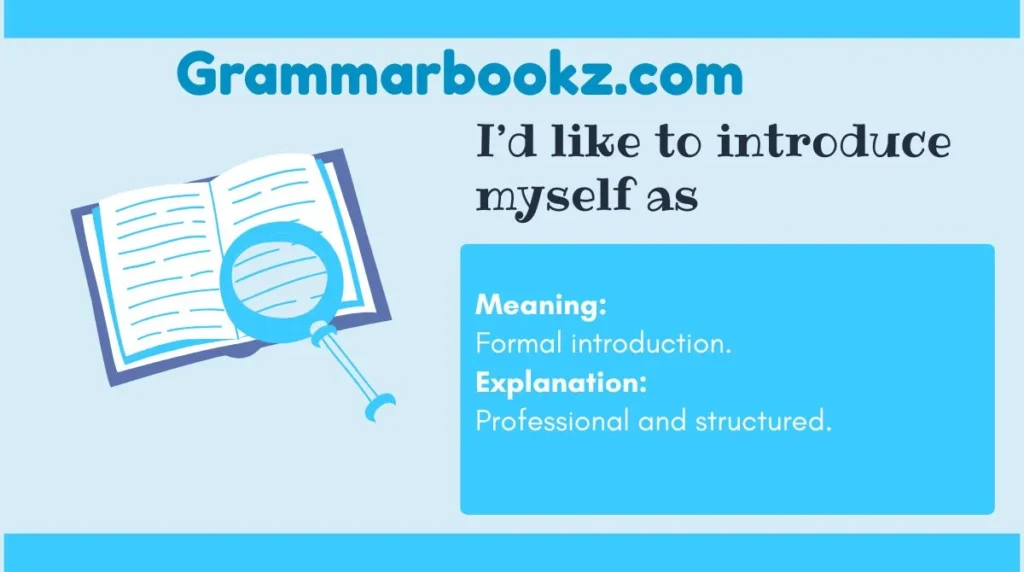
Meaning: Formal introduction.
Explanation: Professional and structured.
Grammar Note: Verb phrase.
Example Sentence: “I’d like to introduce myself as the new manager.”
Best Use: Business settings.
Worst Use: Text messages.
Tone: Professional
Level: Advanced
Similarity Score: 6/10
Replaceability Tip: Use when role matters.
My full name is
Meaning: States complete name.
Explanation: Useful for clarity.
Grammar Note: Noun phrase.
Example Sentence: “My full name is Daniel Robert Lee.”
Best Use: Forms, interviews.
Worst Use: Casual talk.
Tone: Neutral
Level: Beginner
Similarity Score: 9/10
Replaceability Tip: Use when precision is needed.
I’m known as
Meaning: How people recognize you.
Explanation: Suggests reputation or title.
Grammar Note: Passive phrase.
Example Sentence: “I’m known as Chris in the office.”
Best Use: Informal professional.
Worst Use: Legal contexts.
Tone: Neutral
Level: Intermediate
Similarity Score: 7/10
Replaceability Tip: Use when name differs socially.
I represent
Meaning: Speaking on behalf of someone.
Explanation: Focuses on role.
Grammar Note: Verb phrase.
Example Sentence: “I represent the marketing team.”
Best Use: Business meetings.
Worst Use: Personal introductions.
Tone: Professional
Level: Advanced
Similarity Score: 4/10
Replaceability Tip: Use when identity is role-based.
Speaking is
Meaning: Phone introduction.
Explanation: Common in customer service.
Grammar Note: Present participle.
Example Sentence: “Speaking is John from support.”
Best Use: Phone calls.
Worst Use: Writing.
Tone: Professional
Level: Intermediate
Similarity Score: 5/10
Replaceability Tip: Use on calls only.
This is [Name] speaking
Meaning: Clear phone identification.
Explanation: Formal and polite.
Grammar Note: Fixed phrase.
Example Sentence: “This is Anna speaking.”
Best Use: Business calls.
Worst Use: Casual chats.
Tone: Professional
Level: Intermediate
Similarity Score: 6/10
Replaceability Tip: Use in customer communication.
Let me introduce myself
Meaning: Polite self-introduction.
Explanation: Friendly but respectful.
Grammar Note: Imperative phrase.
Example Sentence: “Let me introduce myself. I’m Paul.”
Best Use: Meetings.
Worst Use: Texting.
Tone: Polite
Level: Intermediate
Similarity Score: 6/10
Replaceability Tip: Good opening line.
I’m pleased to introduce myself
Meaning: Polite and formal.
Explanation: Shows respect.
Grammar Note: Formal phrase.
Example Sentence: “I’m pleased to introduce myself as your host.”
Best Use: Formal events.
Worst Use: Casual settings.
Tone: Formal
Level: Advanced
Similarity Score: 5/10
Replaceability Tip: Use in speeches.
My given name is
Meaning: Birth name.
Explanation: Formal and precise.
Grammar Note: Noun phrase.
Example Sentence: “My given name is Hassan.”
Best Use: Official contexts.
Worst Use: Casual talk.
Tone: Formal
Level: Advanced
Similarity Score: 7/10
Replaceability Tip: Use when legal clarity matters.
I prefer to be called
Meaning: States preference.
Explanation: Polite and clear.
Grammar Note: Verb phrase.
Example Sentence: “I prefer to be called Liz.”
Best Use: Workplace.
Worst Use: Very formal writing.
Tone: Soft
Level: Intermediate
Similarity Score: 8/10
Replaceability Tip: Ideal for nicknames.
People call me
Meaning: Common name used by others.
Explanation: Casual and friendly.
Grammar Note: Verb phrase.
Example Sentence: “People call me Ben.”
Best Use: Informal conversation.
Worst Use: Professional emails.
Tone: Friendly
Level: Beginner
Similarity Score: 7/10
Replaceability Tip: Use socially.
I answer to
Meaning: Informal way to state name.
Explanation: Playful tone.
Grammar Note: Idiomatic phrase.
Example Sentence: “I answer to Nick.”
Best Use: Casual talk.
Worst Use: Business settings.
Tone: Casual
Level: Advanced
Similarity Score: 5/10
Replaceability Tip: Use humor carefully.
I’m referred to as
Meaning: How others address you.
Explanation: Formal and indirect.
Grammar Note: Passive phrase.
Example Sentence: “I’m referred to as Dr. Khan.”
Best Use: Academic contexts.
Worst Use: Casual chat.
Tone: Formal
Level: Advanced
Similarity Score: 6/10
Replaceability Tip: Use in formal writing.
It’s
Meaning: Short casual introduction.
Explanation: Very informal.
Grammar Note: Contraction.
Example Sentence: “It’s Tom.”
Best Use: Calls with friends.
Worst Use: Professional contexts.
Tone: Casual
Level: Beginner
Similarity Score: 6/10
Replaceability Tip: Avoid formal use.
I’m known professionally as
Meaning: Professional identity.
Explanation: Clear and formal.
Grammar Note: Adverbial phrase.
Example Sentence: “I’m known professionally as A. Malik.”
Best Use: Business profiles.
Worst Use: Casual settings.
Tone: Professional
Level: Advanced
Similarity Score: 7/10
Replaceability Tip: Use for branding.
I’d like to present myself as
Meaning: Formal self-presentation.
Explanation: Strong professional tone.
Grammar Note: Verb phrase.
Example Sentence: “I’d like to present myself as a candidate.”
Best Use: Interviews.
Worst Use: Casual talk.
Tone: Formal
Level: Advanced
Similarity Score: 5/10
Replaceability Tip: Use when positioning yourself.
This is [Name]
Meaning: Simple introduction.
Explanation: Common in calls and meetings.
Grammar Note: Demonstrative phrase.
Example Sentence: “This is Emma from accounts.”
Best Use: Professional calls.
Worst Use: Essays.
Tone: Neutral
Level: Beginner
Similarity Score: 8/10
Replaceability Tip: Use for quick clarity.
Mini Dialogue Examples
Formal:
“Good morning. Allow me to introduce myself. I’m Mr. Stevens from the legal team.”
Informal:
“Hey! I’m Jake. Nice to meet you.”
Business Email:
“Hello,
This is Sarah Ahmed speaking from the finance department.”
Mistakes to Avoid
- Overusing “my name is” in professional writing
- Using slang introductions in formal emails
- Forgetting tone and context
- Mixing casual phrases with academic writing
- Using contractions in legal documents
- Being unclear about name preference
Cultural & Tone Tips
In US English, short forms like “I’m” are common and friendly.
In UK English, formal introductions appear more often in work settings.
In casual social English, names are often introduced indirectly or with humor.
Tone always matters more than grammar.
Comparison Table
| Phrase | Tone | Best Context | Professional Level | Example |
|---|---|---|---|---|
| I’m | Friendly | Daily speech | Low | “I’m Alex.” |
| Allow me to introduce myself | Formal | Meetings | High | “Allow me to introduce myself.” |
| You can call me | Soft | Social/work | Medium | “You can call me Sam.” |
| This is [Name] | Neutral | Calls | Medium | “This is Lina.” |
| I’m known professionally as | Professional | Branding | High | “I’m known professionally as…” |
FAQs
Is “my name is” rude?
No. It is polite and neutral.
Is it okay in emails?
Yes, but alternatives sound more professional.
What is the most formal alternative?
“Allow me to introduce myself.”
What is the most polite alternative?
“I’d like to introduce myself as…”
What should beginners use?
“I’m” or “My name is.”
Can I use casual phrases at work?
Only in relaxed or familiar environments.
Conclusion
Using different ways to say “my name is” helps you sound confident, fluent, and professional. While the original phrase is correct, variety improves clarity and tone.
Whether you are writing an email, attending a meeting, or starting a conversation, the right introduction sets the mood. Practice these alternatives in real situations.
Over time, they will feel natural—and your English will feel stronger.

John Lee is an education-focused writer with a strong interest in English grammar and language learning.
He creates clear, student-friendly content to help learners improve their grammar skills with confidence.