
In professional and everyday communication, mistakes happen. You send an email too early. You share the wrong file. You forget an attachment.
That’s when the phrase “please disregard my previous email” comes in handy.
This phrase politely asks the reader to ignore a message sent earlier. While it works, using it repeatedly can sound stiff, repetitive, or overly formal.
Choosing the right alternative can improve clarity, soften your tone, and make you sound more natural and confident—especially in emails, workplace communication, academic writing, and business conversations.
Strong word choice matters. It affects how polite, professional, or friendly you sound. Native speakers often vary their language depending on context.
Formal: “Please disregard my previous email.”
Informal: “Sorry—ignore my last message.”
Knowing when and how to switch expressions is a powerful skill for English learners and professionals alike.
What Does “Please Disregard My Previous Email” Mean?
Student-friendly definition:
It means asking someone to ignore a message you sent earlier because it is incorrect, outdated, or no longer relevant.
Grammar form:
Formal polite request phrase
Main verb: disregard (verb meaning “to ignore”)
Similar tone synonyms:
Ignore my last email
Please overlook my earlier message
Opposite meaning:
Please refer to my previous email
As mentioned earlier
Sample sentences:
- Please disregard my previous email—I’ve attached the correct document here.
- Kindly disregard the message sent earlier today.
When to Use “Please Disregard My Previous Email”
Spoken English
Used rarely. Sounds formal in speech. More common in offices.
Business English
Very common in professional emails, client communication, and official updates.
Emails / Messages
Best for correcting mistakes or sending updated information.
Social Media
Too formal. Sounds unnatural.
Academic Writing
Acceptable in emails to professors or administration.
Professional Meetings
Used verbally only in formal corporate settings.
Is “Please Disregard My Previous Email” Polite or Professional?
Yes, it is polite and professional—but very formal.
Tone levels explained:
- Polite: Yes
- Neutral: Slightly formal
- Strong: No
- Soft: Moderately
- Formal: High
- Informal: No
Etiquette tip:
Better for workplace and corporate emails. Avoid using it with friends or casual colleagues—it may sound distant or stiff.
Pros & Cons of Using “Please Disregard My Previous Email”
✔ Pros:
- Clear and direct
- Polite and respectful
- Widely accepted in professional settings
✘ Cons:
- Sounds stiff or robotic
- Overused in business emails
- Not suitable for casual communication
Quick Alternatives List (For Busy Readers)
- Please ignore my last email
- Kindly disregard the previous message
- Sorry, please ignore my earlier email
- Please note the correction below
- My apologies—please overlook my last message
- Please refer to this updated email instead
- Correction to my previous email
- Please disregard the earlier information
- Please ignore the message sent earlier
- Updated information below
- Please consider this message instead
- Apologies for the confusion—ignore my last email
- Please treat the earlier email as void
- Please disregard the previous communication
- Kindly ignore my earlier note
- Please see the revised details below
- Please accept this as the correct version
- Please ignore my previous message
- Correction: please see below
- Updated email—please disregard the earlier one
- Please replace my earlier email with this one
21 Detailed Alternatives and How to Use Them
Please ignore my last email
Meaning:
Ask the reader not to consider your previous email.
Explanation:
This is the most common and natural alternative. It sounds polite but less stiff than “disregard.”
Grammar Note:
Imperative polite request
Example Sentence:
Please ignore my last email—I’ve updated the details here.
Best Use:
Email, workplace
Worst Use:
Formal legal communication
Tone:
Professional, neutral
Level:
Beginner
Similarity Score:
9/10
Replaceability Tip:
Use this when you want to sound clear and natural.
Kindly disregard the previous message
Meaning:
Politely ask someone to ignore an earlier message.
Explanation:
“Kindly” adds extra politeness, often used in formal or international business English.
Grammar Note:
Formal request phrase
Example Sentence:
Kindly disregard the previous message and refer to the updated file.
Best Use:
Formal emails, clients
Worst Use:
Casual chats
Tone:
Formal, polite
Level:
Intermediate
Similarity Score:
10/10
Replaceability Tip:
Choose this when writing to senior staff or clients.
Sorry—please ignore my earlier email
Meaning:
Apologize and ask to ignore a previous message.
Explanation:
Adds a human touch by acknowledging the mistake.
Grammar Note:
Apology + request
Example Sentence:
Sorry—please ignore my earlier email. I sent the wrong attachment.
Best Use:
Workplace, friendly professional emails
Worst Use:
Legal or official notices
Tone:
Soft, polite
Level:
Beginner
Similarity Score:
9/10
Replaceability Tip:
Best when the mistake is minor.
Please note the correction below
Meaning:
Direct attention to updated or corrected information.
Explanation:
Professional and efficient. Focuses on the correction rather than the mistake.
Grammar Note:
Formal instructional phrase
Example Sentence:
Please note the correction below regarding the meeting time.
Best Use:
Business, academic emails
Worst Use:
Casual messaging
Tone:
Professional, neutral
Level:
Intermediate
Similarity Score:
7/10
Replaceability Tip:
Use when you want to sound confident and efficient.
My apologies—please overlook my last message
Meaning:
Apologize and ask forgiveness for a mistake.
Explanation:
More emotional and respectful than “ignore.”
Grammar Note:
Formal apology phrase
Example Sentence:
My apologies—please overlook my last message.
Best Use:
Formal workplace emails
Worst Use:
Fast-paced chats
Tone:
Polite, formal
Level:
Advanced
Similarity Score:
8/10
Replaceability Tip:
Use when the error caused confusion.
Please refer to this updated email instead
Meaning:
Ask the reader to focus on the current message.
Explanation:
Shifts attention forward rather than backward.
Grammar Note:
Instructional phrase
Example Sentence:
Please refer to this updated email instead for accurate details.
Best Use:
Professional emails
Worst Use:
Casual texting
Tone:
Professional
Level:
Intermediate
Similarity Score:
7/10
Replaceability Tip:
Good when sending corrected data.
Correction to my previous email
Meaning:
Announces that a mistake is being corrected.
Explanation:
Often used as an email subject line.
Grammar Note:
Noun phrase
Example Sentence:
Correction to my previous email: the deadline is Friday.
Best Use:
Business email subject lines
Worst Use:
Spoken English
Tone:
Neutral, professional
Level:
Beginner
Similarity Score:
6/10
Replaceability Tip:
Ideal for clarity in inboxes.
Please disregard the earlier information
Meaning:
Ask the reader to ignore outdated content.
Explanation:
Slightly softer than “previous email.”
Grammar Note:
Formal phrase
Example Sentence:
Please disregard the earlier information and see below.
Best Use:
Professional writing
Worst Use:
Casual messages
Tone:
Formal
Level:
Intermediate
Similarity Score:
8/10
Replaceability Tip:
Useful when information changes quickly.
Apologies for the confusion—ignore my last email
Meaning:
Acknowledge confusion and correct it.
Explanation:
Shows responsibility and empathy.
Grammar Note:
Apology clause + request
Example Sentence:
Apologies for the confusion—ignore my last email.
Best Use:
Workplace communication
Worst Use:
Very formal contexts
Tone:
Friendly professional
Level:
Intermediate
Similarity Score:
9/10
Replaceability Tip:
Great when multiple emails were sent.
Please treat the earlier email as void
Meaning:
Declare the previous email invalid.
Explanation:
Strong and formal. Common in legal or corporate language.
Grammar Note:
Formal declarative phrase
Example Sentence:
Please treat the earlier email as void.
Best Use:
Legal, corporate emails
Worst Use:
Casual use
Tone:
Strong, formal
Level:
Advanced
Similarity Score:
8/10
Replaceability Tip:
Use when accuracy is critical.
Please see the revised details below
Meaning:
Ask the reader to review corrected information.
Explanation:
Polite and solution-focused.
Grammar Note:
Instructional phrase
Example Sentence:
Please see the revised details below.
Best Use:
Business emails
Worst Use:
Social chats
Tone:
Professional
Level:
Beginner
Similarity Score:
6/10
Replaceability Tip:
Best when changes are small.
Please accept this as the correct version
Meaning:
Clarify which message is accurate.
Explanation:
Confident and final.
Grammar Note:
Formal acceptance phrase
Example Sentence:
Please accept this as the correct version of the report.
Best Use:
Formal professional communication
Worst Use:
Casual texting
Tone:
Formal, professional
Level:
Advanced
Similarity Score:
7/10
Replaceability Tip:
Use when finalizing information.
Please replace my earlier email with this one
Meaning:
Ask the reader to substitute messages.
Explanation:
Clear and direct.
Grammar Note:
Instructional phrase
Example Sentence:
Please replace my earlier email with this one.
Best Use:
Workplace email
Worst Use:
Informal contexts
Tone:
Neutral
Level:
Intermediate
Similarity Score:
8/10
Replaceability Tip:
Good when correcting files or data.
Updated information below
Meaning:
Announce new information.
Explanation:
Short and efficient.
Grammar Note:
Noun phrase
Example Sentence:
Updated information below regarding the schedule.
Best Use:
Internal emails
Worst Use:
Formal letters
Tone:
Neutral
Level:
Beginner
Similarity Score:
5/10
Replaceability Tip:
Use for quick updates.
Please ignore the message sent earlier
Meaning:
Ask to ignore an earlier message.
Explanation:
Slightly more formal than “last email.”
Grammar Note:
Formal request
Example Sentence:
Please ignore the message sent earlier today.
Best Use:
Professional email
Worst Use:
Casual conversation
Tone:
Formal-neutral
Level:
Beginner
Similarity Score:
9/10
Replaceability Tip:
Safe alternative in most workplaces.
Kindly ignore my earlier note
Meaning:
Politely ask to ignore a short message.
Explanation:
“Note” sounds lighter than “email.”
Grammar Note:
Formal phrase
Example Sentence:
Kindly ignore my earlier note.
Best Use:
Office communication
Worst Use:
Legal writing
Tone:
Polite
Level:
Intermediate
Similarity Score:
8/10
Replaceability Tip:
Good for internal teams.
Please consider this message instead
Meaning:
Direct attention to the current message.
Explanation:
Positive and forward-focused.
Grammar Note:
Instructional phrase
Example Sentence:
Please consider this message instead.
Best Use:
Emails, workplace
Worst Use:
Formal contracts
Tone:
Professional
Level:
Intermediate
Similarity Score:
7/10
Replaceability Tip:
Use to reduce emphasis on mistakes.
Correction: please see below
Meaning:
Indicates a correction.
Explanation:
Very common in subject lines.
Grammar Note:
Label phrase
Example Sentence:
Correction: please see below for updated numbers.
Best Use:
Business emails
Worst Use:
Casual chat
Tone:
Neutral
Level:
Beginner
Similarity Score:
6/10
Replaceability Tip:
Best for clarity.
Please disregard the previous communication
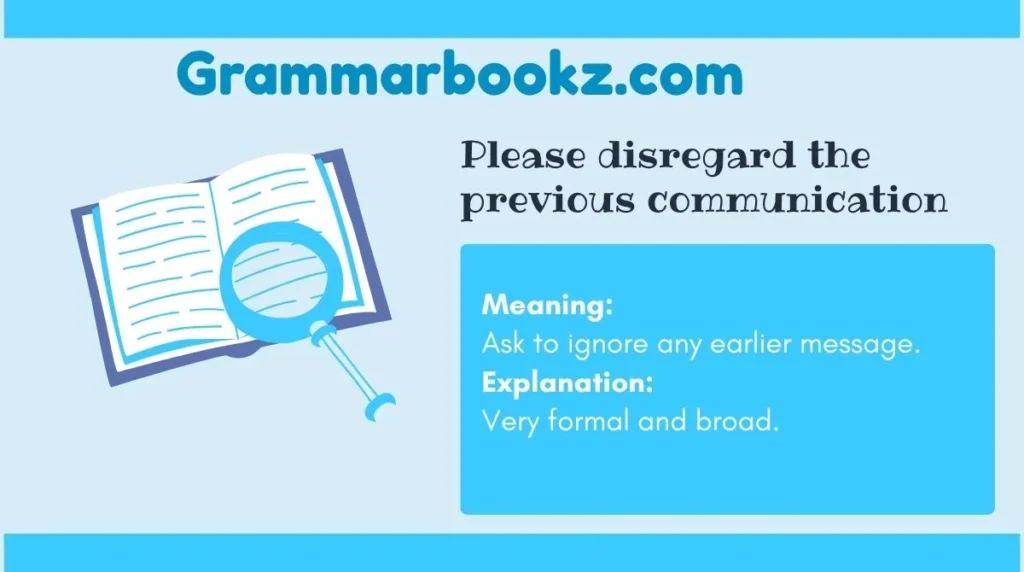
Meaning:
Ask to ignore any earlier message.
Explanation:
Very formal and broad.
Grammar Note:
Formal phrase
Example Sentence:
Please disregard the previous communication.
Best Use:
Corporate, legal
Worst Use:
Friendly emails
Tone:
Formal
Level:
Advanced
Similarity Score:
8/10
Replaceability Tip:
Use only in formal settings.
Sorry about that—ignore my last message
Meaning:
Casual apology and correction.
Explanation:
Friendly and human.
Grammar Note:
Informal apology phrase
Example Sentence:
Sorry about that—ignore my last message.
Best Use:
Casual workplace, chat apps
Worst Use:
Formal business emails
Tone:
Friendly, informal
Level:
Beginner
Similarity Score:
8/10
Replaceability Tip:
Best with teammates you know well.
Mini Dialogue Examples
Formal conversation
Manager: Please disregard my previous email. The policy has been updated.
Informal conversation
Colleague: Sorry—ignore my last message. I figured it out.
Business email style
Subject: Correction
Body: Please ignore my last email and refer to the updated document attached.
Mistakes to Avoid (Common Learner Errors)
- Using very formal phrases with friends
- Forgetting to apologize when needed
- Overusing “disregard” in every email
- Sounding rude by skipping polite words
- Mixing casual tone in formal emails
- Writing long explanations instead of clear corrections
- Using slang in professional settings
Cultural & Tone Tips
US English:
Direct but polite alternatives are preferred. “Please ignore my last email” sounds natural.
UK English:
Softer phrases like “Kindly disregard” or “My apologies” are common.
Casual social English:
People prefer short apologies: “Oops—ignore that.”
Comparison Table of Best Alternatives
| Phrase | Tone | Best Context | Professional Level | Example |
|---|---|---|---|---|
| Please ignore my last email | Neutral | Work email | Medium | Please ignore my last email. |
| Kindly disregard the previous message | Formal | Clients | High | Kindly disregard the previous message. |
| Sorry—ignore my earlier email | Friendly | Office | Medium | Sorry—ignore my earlier email. |
| Please note the correction below | Professional | Business | High | Please note the correction below. |
| Please treat the earlier email as void | Strong | Legal | Very High | Please treat the earlier email as void. |
FAQs
Is “please disregard my previous email” rude?
No. It is polite and professional.
Is it okay to use it in emails?
Yes, especially in formal or business emails.
What is the most formal alternative?
“Please treat the earlier email as void.”
What is the most polite alternative?
“Kindly disregard the previous message.”
What should beginners use?
“Please ignore my last email.”
Can I use it with coworkers?
Yes, but softer alternatives often sound better.
Conclusion
Using varied language makes your English sound natural, confident, and professional. While “please disregard my previous email” is correct, relying on it too often can feel stiff or repetitive.
Learning alternatives helps you adjust tone, show politeness, and communicate clearly in different situations.
Whether you’re writing business emails, correcting mistakes, or chatting with colleagues, the right phrase builds trust and fluency.
Practice switching between formal and informal options. Over time, your communication will feel smoother, more natural, and more professional.

John Lee is an education-focused writer with a strong interest in English grammar and language learning.
He creates clear, student-friendly content to help learners improve their grammar skills with confidence.