
The phrase “please forward this email” is common in everyday communication. You see it at work. You read it in professional emails.
You may even use it without thinking. It simply asks someone to send an email to another person or group.
But here’s the problem. When the same phrase is repeated again and again, it can sound boring, cold, or even impolite in some situations. Word choice matters.
The way you ask someone to forward a message changes the tone. It can sound polite, firm, friendly, or professional—depending on how you say it.
Using varied expressions helps you sound fluent. It improves clarity. It shows professionalism in business and confidence in daily English.
Formal: Kindly share this message with the relevant team.
Informal: Can you pass this along?
Same idea. Very different tone.
This guide will help you choose the right words every time.
What Does “Please Forward This Email” Mean?
Simple definition:
It is a polite request asking someone to send an email to another person or group.
Grammar form:
Imperative sentence with a polite marker (“please”).
Main verb: forward (action verb).
Similar meanings:
- Please share this email
- Please pass this along
- Kindly send this onward
Opposite tone ideas:
- Keep this confidential
- Do not share
Example sentences:
- Please forward this email to your manager.
- Could you please forward this message to the team?
When to Use “Please Forward This Email”
Spoken English
Used less often in speech. Sounds formal. Better for workplace talk.
Business English
Very common. Safe but plain. Often used in internal emails.
Emails and Messages
Works well when clarity matters more than tone.
Social Media
Rarely used. Sounds too formal for public platforms.
Academic Writing
Usually avoided. Replaced with formal instructions.
Professional Meetings
Used verbally only in formal office settings.
Is “Please Forward This Email” Polite or Professional?
This phrase is polite but neutral. It does not sound warm or rude. It is direct and clear.
Tone levels explained:
- Polite: Uses “please”
- Neutral: No emotion
- Formal: Acceptable in offices
- Soft: Lacks friendliness
- Strong: Not commanding
Etiquette tip:
Good for internal emails. Avoid overusing it in client-facing or high-level corporate communication. Choose softer or more professional alternatives instead.
Pros & Cons of Using “Please Forward This Email”
✔ Pros:
- Clear and direct
- Easy for learners
- Widely understood
- Safe in professional settings
✘ Cons:
- Sounds repetitive
- Lacks warmth
- Can feel robotic
- Not suitable for all contexts
Quick Alternatives List (For Busy Readers)
- Kindly share this email
- Please pass this along
- Could you forward this message?
- Please circulate this email
- Feel free to share this
- Please send this onward
- Would you mind forwarding this?
- Please distribute this message
- Kindly relay this information
- Can you pass this on?
- Please share with the team
- Forward as needed
- Please copy the relevant parties
- Kindly disseminate this
- Please send this to others
- Help share this email
- Please ensure this is forwarded
- Could you share this update?
- Please loop others in
- Kindly forward for awareness
Main Alternatives Explained in Detail
Kindly share this email
Meaning:
A polite way to ask someone to send the email to others.
Explanation:
“Kindly” sounds respectful and formal. Often used in professional or international communication.
Grammar Note:
Formal phrase with adverb “kindly.”
Example Sentence:
Kindly share this email with the concerned department.
Best Use:
Formal emails, workplace, corporate settings
Worst Use:
Casual chats or texting friends
Tone:
Formal, professional
Level:
Intermediate
Similarity Score:
9/10
Replaceability Tip:
Use this when writing to about or external partners.
Please pass this along
Meaning:
Ask someone to forward information.
Explanation:
Friendly and natural. Common in spoken and written English.
Grammar Note:
Phrasal verb.
Example Sentence:
Please pass this along to anyone who needs it.
Best Use:
Emails, messages, informal workplaces
Worst Use:
Very formal documents
Tone:
Friendly, neutral
Level:
Beginner
Similarity Score:
8/10
Replaceability Tip:
Choose this when you want to sound relaxed.
Could you forward this message?
Meaning:
A polite request question.
Explanation:
Softer than commands. Shows respect.
Grammar Note:
Modal verb question.
Example Sentence:
Could you forward this message to your supervisor?
Best Use:
Emails, professional messages
Worst Use:
Urgent commands
Tone:
Polite, professional
Level:
Beginner
Similarity Score:
10/10
Replaceability Tip:
Perfect for polite business emails.
Please circulate this email
Meaning:
Send the email to many people.
Explanation:
Common in offices and teams.
Grammar Note:
Formal verb “circulate.”
Example Sentence:
Please circulate this email among the staff.
Best Use:
Corporate emails, announcements
Worst Use:
One-to-one messages
Tone:
Formal
Level:
Intermediate
Similarity Score:
8/10
Replaceability Tip:
Use when many recipients are involved.
Would you mind forwarding this?
Meaning:
Very polite request.
Explanation:
Sounds gentle and respectful.
Grammar Note:
Polite question structure.
Example Sentence:
Would you mind forwarding this to the HR team?
Best Use:
Professional emails, polite requests
Worst Use:
Emergency instructions
Tone:
Soft, polite
Level:
Beginner
Similarity Score:
9/10
Replaceability Tip:
Use when asking for a favor.
Please share this with the team
Meaning:
Ask someone to send information to a group.
Explanation:
Clear and modern business English.
Grammar Note:
Imperative sentence.
Example Sentence:
Please share this with the team by today.
Best Use:
Workplace emails
Worst Use:
Formal legal communication
Tone:
Professional, neutral
Level:
Beginner
Similarity Score:
8/10
Replaceability Tip:
Great for internal updates.
Kindly relay this information
Meaning:
Pass the message accurately.
Explanation:
Very formal. Emphasizes accuracy.
Grammar Note:
Formal verb “relay.”
Example Sentence:
Kindly relay this information to all stakeholders.
Best Use:
Formal communication
Worst Use:
Casual talk
Tone:
Formal
Level:
Advanced
Similarity Score:
7/10
Replaceability Tip:
Use in official notices.
Please ensure this is forwarded
Meaning:
Strong request for action.
Explanation:
Adds responsibility.
Grammar Note:
Formal structure.
Example Sentence:
Please ensure this is forwarded to the legal team.
Best Use:
Serious business emails
Worst Use:
Friendly messages
Tone:
Strong, professional
Level:
Intermediate
Similarity Score:
9/10
Replaceability Tip:
Use when the task is important.
Can you pass this on?
Meaning:
Casual way to ask for forwarding.
Explanation:
Short and friendly.
Grammar Note:
Informal question.
Example Sentence:
Can you pass this on to John?
Best Use:
Texts, chats
Worst Use:
Formal emails
Tone:
Informal
Level:
Beginner
Similarity Score:
7/10
Replaceability Tip:
Use with colleagues you know well.
Please distribute this message
Meaning:
Send to multiple recipients.
Explanation:
Formal and clear.
Grammar Note:
Formal verb “distribute.”
Example Sentence:
Please distribute this message to all departments.
Best Use:
Official announcements
Worst Use:
Personal emails
Tone:
Formal
Level:
Intermediate
Similarity Score:
8/10
Replaceability Tip:
Use in structured organizations.
Feel free to share this
Meaning:
Gives permission to forward.
Explanation:
Friendly and relaxed.
Grammar Note:
Idiomatic phrase.
Example Sentence:
Feel free to share this with others.
Best Use:
Casual emails, social platforms
Worst Use:
Strict instructions
Tone:
Friendly
Level:
Beginner
Similarity Score:
6/10
Replaceability Tip:
Use when sharing is optional.
Please send this onward
Meaning:
Forward the message.
Explanation:
Slightly formal, neutral.
Grammar Note:
Adverbial phrase.
Example Sentence:
Please send this onward to the client.
Best Use:
Emails
Worst Use:
Casual chat
Tone:
Neutral
Level:
Intermediate
Similarity Score:
7/10
Replaceability Tip:
Use when avoiding repetition.
Kindly disseminate this email
Meaning:
Spread information widely.
Explanation:
Very formal and academic.
Grammar Note:
Advanced formal verb.
Example Sentence:
Kindly disseminate this email to all branches.
Best Use:
Formal notices
Worst Use:
Daily conversation
Tone:
Highly formal
Level:
Advanced
Similarity Score:
6/10
Replaceability Tip:
Use sparingly.
Please copy the relevant parties
Meaning:
Include others in the email.
Explanation:
Specific to email actions.
Grammar Note:
Business phrase.
Example Sentence:
Please copy the relevant parties in your reply.
Best Use:
Professional emails
Worst Use:
Non-email contexts
Tone:
Professional
Level:
Intermediate
Similarity Score:
5/10
Replaceability Tip:
Use when CC is needed.
Please loop others in
Meaning:
Include others in communication.
Explanation:
Modern business English.
Grammar Note:
Idiomatic phrase.
Example Sentence:
Please loop others in if needed.
Best Use:
Workplace emails
Worst Use:
Formal letters
Tone:
Friendly professional
Level:
Intermediate
Similarity Score:
6/10
Replaceability Tip:
Good for collaborative teams.
Please share this update
Meaning:
Forward new information.
Explanation:
Clear and friendly.
Grammar Note:
Imperative sentence.
Example Sentence:
Please share this update with management.
Best Use:
Business emails
Worst Use:
Casual chat
Tone:
Neutral
Level:
Beginner
Similarity Score:
8/10
Replaceability Tip:
Use for news or changes.
Forward as needed
Meaning:
Forward if necessary.
Explanation:
Short and flexible.
Grammar Note:
Instruction phrase.
Example Sentence:
Forward as needed for awareness.
Best Use:
Internal emails
Worst Use:
Clear instructions
Tone:
Neutral
Level:
Intermediate
Similarity Score:
6/10
Replaceability Tip:
Use when optional.
Please relay this message
Meaning:
Pass the message accurately.
Explanation:
Formal and precise.
Grammar Note:
Formal verb.
Example Sentence:
Please relay this message to the client.
Best Use:
Professional communication
Worst Use:
Casual messages
Tone:
Formal
Level:
Intermediate
Similarity Score:
8/10
Replaceability Tip:
Use when accuracy matters.
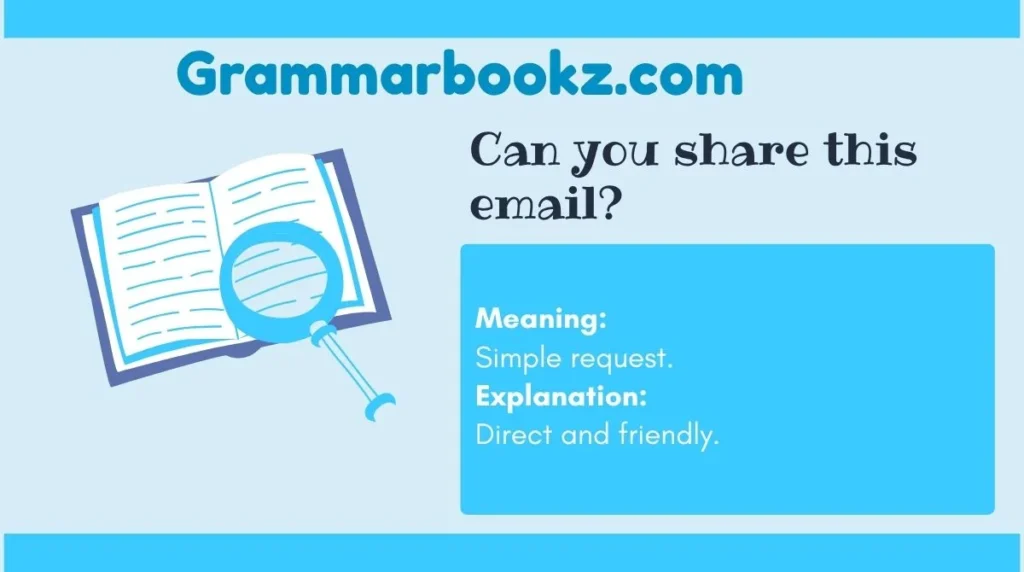
Can you share this email?
Meaning:
Simple request.
Explanation:
Direct and friendly.
Grammar Note:
Question form.
Example Sentence:
Can you share this email with Sarah?
Best Use:
Emails, chats
Worst Use:
Very formal contexts
Tone:
Friendly
Level:
Beginner
Similarity Score:
9/10
Replaceability Tip:
Good everyday alternative.
Please forward for awareness
Meaning:
Send so others are informed.
Explanation:
Common in offices.
Grammar Note:
Business phrase.
Example Sentence:
Please forward for awareness.
Best Use:
Internal emails
Worst Use:
External clients
Tone:
Professional
Level:
Intermediate
Similarity Score:
7/10
Replaceability Tip:
Use for informational emails.
Mini Dialogue Examples
Formal:
Manager: Kindly share this email with the finance department.
Assistant: Of course.
Informal:
Colleague: Can you pass this on to Mike?
You: Sure, no problem.
Business Email Style:
Hello Sarah,
Could you please forward this message to the team?
Thank you.
Mistakes to Avoid
- Using very formal phrases in casual chats
- Sounding too casual with senior staff
- Forgetting “please” in polite requests
- Using “forward” in spoken casual English
- Overusing one phrase repeatedly
- Using strong commands with clients
- Mixing slang with formal emails
Cultural & Tone Tips
In US English, friendly alternatives are preferred.
In UK English, polite and soft wording is valued.
In casual social English, short phrases like pass this on sound natural.
Native speakers adjust tone based on relationship and setting.
Comparison Table of Best Alternatives
| Phrase | Tone | Best Context | Professional Level | Example |
|---|---|---|---|---|
| Kindly share this email | Formal | Corporate emails | High | Kindly share this email with HR |
| Please pass this along | Friendly | Work chats | Medium | Please pass this along |
| Could you forward this message? | Polite | Emails | Medium | Could you forward this message? |
| Please circulate this email | Formal | Announcements | High | Please circulate this email |
| Can you pass this on? | Informal | Texts | Low | Can you pass this on? |
FAQs
Is “please forward this email” rude?
No. It is polite but neutral.
Is it okay in emails?
Yes. It is commonly used in professional emails.
What is the most formal alternative?
Kindly disseminate this email.
What is the most polite alternative?
Would you mind forwarding this?
What should beginners use?
Could you forward this message?
Can I use it with clients?
Yes, but softer alternatives are better.
Conclusion
Using only one phrase limits your English. When you learn different ways to say “please forward this email,” your communication becomes clearer, warmer, and more professional.
Small changes in wording can improve tone, build respect, and avoid misunderstandings.
These alternatives help you choose the right expression for emails, meetings, and daily conversation. Practice them.
Try one new phrase each week. Over time, your English will sound more natural and confident.
Good communication is not just about grammar. It is about choosing the right words.

John Lee is an education-focused writer with a strong interest in English grammar and language learning.
He creates clear, student-friendly content to help learners improve their grammar skills with confidence.