
The phrase “thank you for your consideration” is common in English. You see it in emails, job applications, proposals, and polite requests. It shows respect. It shows patience. It shows gratitude.
But when you use the same phrase again and again, it can sound flat, robotic, or overly formal. Native speakers often switch expressions to match tone, context, and relationship. That is why alternatives matter.
The right words can make you sound warmer, more confident, or more professional. They can also help you avoid sounding stiff or distant in everyday communication.
Compare this:
Formal: Thank you for your consideration.
Informal: I really appreciate you taking the time.
Same idea. Different tone. Different impact.
This guide helps English learners and professionals choose the best expression for emails, business writing, academic work, and daily conversation.
What Does “Thank You for Your Consideration” Mean?
Student-friendly meaning:
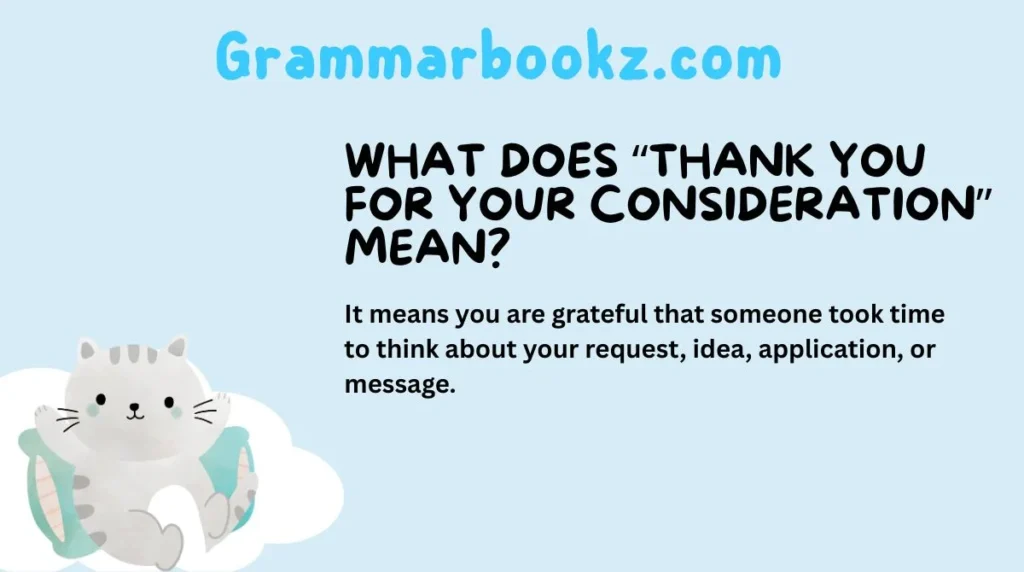
It means you are grateful that someone took time to think about your request, idea, application, or message.
Grammar form:
A polite fixed phrase. It functions as a complete expression of gratitude. Not a verb or idiom.
Similar tone words:
Appreciation, gratitude, thanks, acknowledgment
Opposite tone ideas:
Demanding, impatient, entitled
Example sentences:
- Thank you for your consideration of my application.
- Thank you for your consideration. I look forward to hearing from you.
When to Use “Thank You for Your Consideration”
Spoken English
Used rarely in casual speech. Sounds formal.
Business English
Very common in proposals, pitches, and official communication.
Emails and messages
Perfect for professional emails, especially closing lines.
Social media
Usually too formal. Better alternatives exist.
Academic writing
Acceptable in cover letters, not essays.
Professional meetings
Used when making formal requests or presentations.
Is “Thank You for Your Consideration” Polite or Professional?
This phrase is both polite and professional. It sits on the formal side of English.
Tone levels:
- Polite: Yes
- Neutral: No
- Soft: Yes
- Strong: No
- Formal: Yes
- Informal: No
Etiquette tip:
Better for workplaces, job applications, and formal emails. Avoid it in friendly chats or fast messages. It can feel distant.
Pros and Cons of Using “Thank You for Your Consideration”
✔ Pros:
- Very polite
- Safe in professional settings
- Clear and respectful
- Accepted worldwide
✘ Cons:
- Overused
- Sounds stiff
- Lacks warmth
- Not natural in casual English
Quick Alternatives List (For Busy Readers)
- I appreciate your time
- Thank you for taking the time
- Thanks for reviewing this
- I truly appreciate it
- Many thanks for your time
- I’m grateful for your time and attention
- Thanks for looking into this
- I appreciate your help
- Thank you for reviewing my request
- Much appreciated
- Thanks for considering
- I value your time
- Thank you for your support
- Appreciate your attention
- With appreciation
- Thanks in advance
- I appreciate the opportunity
Strong Alternatives You Can Use Instead
I Appreciate Your Time
Meaning:
You are thankful for the time someone spent.
Explanation:
This phrase feels human and warm. It shows respect without sounding stiff.
Grammar note:
Verb phrase.
Example sentence:
I appreciate your time and look forward to your feedback.
Best use:
Email, workplace, business communication
Worst use:
Very formal legal writing
Tone:
Professional and friendly
Level:
Beginner
Similarity score:
8/10
Replaceability tip:
Use this when you want to sound polite but approachable.
Thank You for Taking the Time
Meaning:
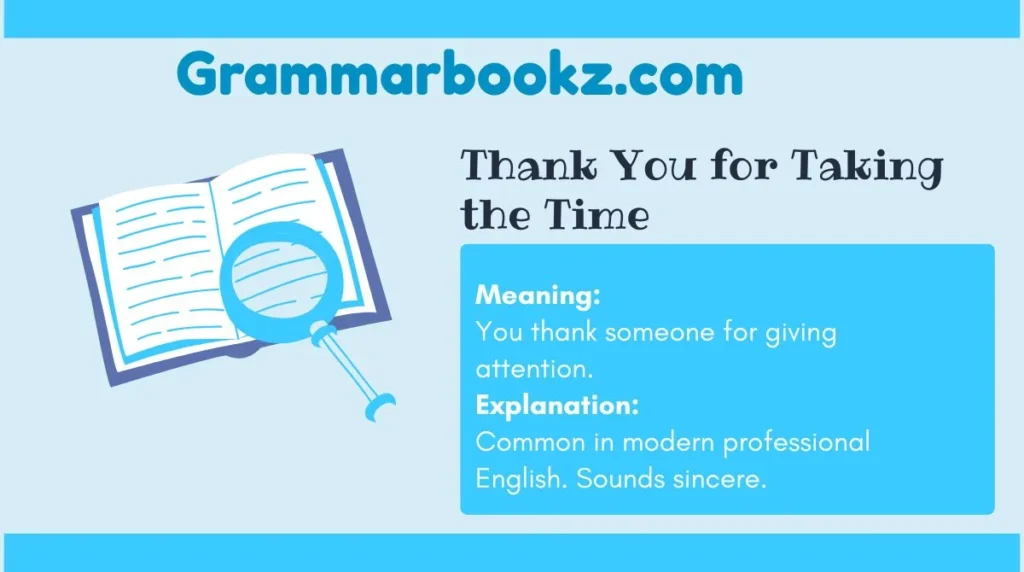
You thank someone for giving attention.
Explanation:
Common in modern professional English. Sounds sincere.
Grammar note:
Fixed polite phrase.
Example sentence:
Thank you for taking the time to review my proposal.
Best use:
Emails, interviews, follow-ups
Worst use:
Text messages between friends
Tone:
Professional
Level:
Beginner
Similarity score:
9/10
Replaceability tip:
Perfect replacement in most business emails.
Thanks for Reviewing This
Meaning:
You thank someone for checking something.
Explanation:
Clear and task-focused. Less formal.
Grammar note:
Casual verb phrase.
Example sentence:
Thanks for reviewing this document.
Best use:
Work chats, internal emails
Worst use:
Job applications
Tone:
Neutral
Level:
Beginner
Similarity score:
7/10
Replaceability tip:
Use when speed matters.
I Truly Appreciate It
Meaning:
Strong personal gratitude.
Explanation:
Adds emotion. Feels sincere and warm.
Grammar note:
Verb phrase with adverb.
Example sentence:
I truly appreciate your support.
Best use:
Emails, conversations
Worst use:
Formal reports
Tone:
Friendly
Level:
Beginner
Similarity score:
6/10
Replaceability tip:
Use when emotion matters more than formality.
Many Thanks for Your Time
Meaning:
A polite way to say thank you.
Explanation:
More British in tone. Formal but friendly.
Grammar note:
Formal noun phrase.
Example sentence:
Many thanks for your time and consideration.
Best use:
UK business emails
Worst use:
Casual texting
Tone:
Formal
Level:
Intermediate
Similarity score:
8/10
Replaceability tip:
Great for polite closings.
I’m Grateful for the Opportunity
Meaning:
You value the chance given.
Explanation:
Positive and forward-looking.
Grammar note:
Adjective phrase.
Example sentence:
I’m grateful for the opportunity to apply.
Best use:
Job applications
Worst use:
Quick replies
Tone:
Professional
Level:
Intermediate
Similarity score:
7/10
Replaceability tip:
Use when thanking for chances, not time.
Thank You for Reviewing My Request
Meaning:
You thank someone for evaluating a request.
Explanation:
Very clear. Direct.
Grammar note:
Formal phrase.
Example sentence:
Thank you for reviewing my request.
Best use:
Formal emails
Worst use:
Social media
Tone:
Formal
Level:
Intermediate
Similarity score:
9/10
Replaceability tip:
Use when clarity is key.
I Appreciate Your Help
Meaning:
You thank someone for assistance.
Explanation:
Friendly and flexible.
Grammar note:
Verb phrase.
Example sentence:
I appreciate your help with this matter.
Best use:
Workplace communication
Worst use:
Very formal letters
Tone:
Friendly
Level:
Beginner
Similarity score:
6/10
Much Appreciated
Meaning:
Short thank you.
Explanation:
Brief and informal.
Grammar note:
Passive phrase.
Example sentence:
Your support is much appreciated.
Best use:
Quick messages
Worst use:
Formal writing
Tone:
Casual
Level:
Beginner
Similarity score:
5/10
Thanks for Considering
Meaning:
Short version of the original phrase.
Explanation:
Casual but polite.
Grammar note:
Verb phrase.
Example sentence:
Thanks for considering my idea.
Best use:
Emails
Worst use:
Formal proposals
Tone:
Neutral
Level:
Beginner
Similarity score:
8/10
With Appreciation
Meaning:
Formal sign-off showing thanks.
Explanation:
Elegant and professional.
Grammar note:
Prepositional phrase.
Example sentence:
With appreciation, John.
Best use:
Formal letters
Worst use:
Casual emails
Tone:
Formal
Level:
Advanced
Similarity score:
6/10
I Value Your Time
Meaning:
You respect their schedule.
Explanation:
Professional and respectful.
Grammar note:
Verb phrase.
Example sentence:
I value your time and attention.
Best use:
Business settings
Worst use:
Friendly chats
Tone:
Professional
Level:
Intermediate
Similarity score:
7/10
Thank You for Your Support
Meaning:
Gratitude for help or backing.
Explanation:
Warm and positive.
Grammar note:
Formal phrase.
Example sentence:
Thank you for your support throughout this process.
Best use:
Workplace
Worst use:
When no support was given
Tone:
Professional
Level:
Beginner
Similarity score:
6/10
I Appreciate Your Attention
Meaning:
Thanks for focus or review.
Explanation:
Formal and respectful.
Grammar note:
Verb phrase.
Example sentence:
I appreciate your attention to this matter.
Best use:
Formal emails
Worst use:
Casual settings
Tone:
Formal
Level:
Intermediate
Similarity score:
8/10
Thanks in Advance
Meaning:
Thanking before action.
Explanation:
Common but risky.
Grammar note:
Adverb phrase.
Example sentence:
Thanks in advance for your help.
Best use:
Friendly requests
Worst use:
Strict corporate emails
Tone:
Neutral
Level:
Beginner
Similarity score:
4/10
I Appreciate the Opportunity to Be Considered
Meaning:
Formal gratitude for evaluation.
Explanation:
Very professional. Strong choice.
Grammar note:
Complex phrase.
Example sentence:
I appreciate the opportunity to be considered.
Best use:
Job applications
Worst use:
Casual emails
Tone:
Formal
Level:
Advanced
Similarity score:
9/10
Thank You for Looking Into This
Meaning:
Thanks for checking an issue.
Explanation:
Friendly and modern.
Grammar note:
Phrasal verb.
Example sentence:
Thank you for looking into this.
Best use:
Workplace emails
Worst use:
Formal letters
Tone:
Neutral
Level:
Beginner
Similarity score:
7/10
Mini Dialogue Examples
Formal conversation
A: We will review your application.
B: Thank you for your consideration.
Informal conversation
A: I’ll check the file later.
B: Thanks for taking the time.
Business email style
I appreciate your time and look forward to your response.
Mistakes to Avoid
- Using formal phrases in casual chats
- Overusing the same expression
- Saying “thanks in advance” in strict workplaces
- Mixing casual tone with formal writing
- Using gratitude when no action happened
- Writing too long thank-you lines
- Forgetting cultural tone differences
Cultural and Tone Tips
In US English, people prefer warmth and clarity. Short thanks feel natural.
In UK English, formal closings like “many thanks” are common.
In casual social English, simple phrases sound best. Over-formality feels cold.
Native speakers care more about tone than grammar perfection.
Comparison Table of Top Alternatives
| Phrase | Tone | Best Context | Professional Level | Example |
|---|---|---|---|---|
| I appreciate your time | Friendly | Medium | I appreciate your time. | |
| Thank you for taking the time | Professional | Business | High | Thank you for taking the time. |
| Many thanks for your time | Formal | UK emails | High | Many thanks for your time. |
| Thanks for reviewing this | Neutral | Workplace | Medium | Thanks for reviewing this. |
| With appreciation | Formal | Letters | High | With appreciation, Alex. |
FAQs
Is “thank you for your consideration” rude?
No. It is polite and respectful.
Is it okay in emails?
Yes. Especially formal emails.
What is the most formal alternative?
“I appreciate the opportunity to be considered.”
What is the most polite alternative?
“Thank you for taking the time.”
What should beginners use?
“I appreciate your time.”
Is it overused?
Yes. That’s why alternatives help.
Conclusion
Using different ways to say thank you for your consideration improves clarity and confidence. It helps you sound natural, respectful, and fluent.
English is not just about correct grammar. It is about tone, timing, and context.
When you choose the right phrase, people feel your sincerity. Practice these alternatives in emails, conversations, and professional writing.
Small changes create strong impressions.

John Lee is an education-focused writer with a strong interest in English grammar and language learning.
He creates clear, student-friendly content to help learners improve their grammar skills with confidence.