“Firstly, secondly, thirdly” is a classic way to organize ideas. It helps listeners and readers follow your points in order. But using it too often can sound repetitive, stiff, or even outdated—especially in modern English.
That’s why learning alternative expressions matters. The words you choose affect tone, clarity, and professionalism.
In business emails, essays, meetings, or daily conversations, varied language makes you sound confident and natural, not robotic.
For example:
Formal:
Firstly, we will review the data. Secondly, we will discuss strategy.
More natural:
To begin with, we will review the data. After that, we will discuss strategy.
Small changes like this improve flow, sound modern, and keep your audience engaged. This guide will help English learners and professionals use strong, clear, and context-appropriate alternatives with confidence.
What Does “Firstly, Secondly, Thirdly” Mean?
Firstly, secondly, thirdly are sequencing words. They show the order of points, steps, or ideas.
They are not verbs or nouns. They are adverbs used for structure.
Simple definition:
They tell the listener what comes first, next, and last.
Similar expressions:
To begin with, next, finally, first of all
Opposite tone (less structured):
Anyway, by the way, random thoughts
Sample sentences:
- Firstly, we need to understand the problem.
- Thirdly, we should test the solution.
When to Use “Firstly, Secondly, Thirdly”
Spoken English
Useful in presentations, but sounds formal.
Business English
Acceptable, but often replaced with smoother phrases.
Emails / Messages
Okay for structured emails, but avoid sounding stiff.
Social Media
Rarely used. Feels too formal.
Academic Writing
Common, but many professors prefer alternatives.
Professional Meetings
Clear, but can sound old-fashioned.
Is “Firstly, Secondly, Thirdly” Polite or Professional?
- Polite: Yes
- Neutral: Yes
- Strong: No
- Soft: Yes
Formal vs Informal:
More formal than casual.
Etiquette tip:
Fine for reports and lectures. Avoid in friendly workplace emails if you want a modern tone.
Pros & Cons of Using “Firstly, Secondly, Thirdly”
✔ Pros
- Very clear
- Easy for beginners
- Logical structure
✘ Cons
- Sounds repetitive
- Can feel stiff
- Less natural in conversation
Quick Alternatives List (For Busy Readers)
- To begin with
- First of all
- In the first place
- Next
- After that
- Then
- Moving on
- Another point is
- Also
- Additionally
- Furthermore
- Moreover
- In addition
- On top of that
- Lastly
- Finally
- To wrap up
- In conclusion
- One reason is
- The next point
- Let’s start with
- Here’s the first thing
- Step one
- Point number one
- The main reason is
25 Powerful Alternatives Explained
To begin with
Meaning: The first point
Explanation: Smooth and natural. Very common in speech and writing.
Grammar Note: Transition phrase
Example Sentence:
To begin with, we need to understand the customer’s needs.
Best Use: Workplace, presentations
Worst Use: Very casual chats
Tone: Professional, soft
Level: Beginner
Similarity Score: 9/10
Replaceability Tip: Use when you want to sound natural, not stiff.
First of all
Meaning: The very first point
Explanation: Slightly stronger than “to begin with.”
Grammar Note: Transition phrase
Example Sentence:
First of all, thank you for joining today’s meeting.
Best Use: Spoken English, emails
Worst Use: Angry arguments
Tone: Friendly, clear
Level: Beginner
Similarity Score: 9/10
Replaceability Tip: Good for opening statements.
In the first place
Meaning: The original or main point
Explanation: Often used to explain reasons.
Grammar Note: Formal phrase
Example Sentence:
In the first place, this policy was created to save costs.
Best Use: Formal writing
Worst Use: Casual talk
Tone: Formal
Level: Intermediate
Similarity Score: 8/10
Replaceability Tip: Use in essays or reports.
Next
Meaning: The following point
Explanation: Simple and flexible.
Grammar Note: Adverb
Example Sentence:
Next, we’ll review the budget.
Best Use: Presentations
Worst Use: Academic essays alone
Tone: Neutral
Level: Beginner
Similarity Score: 7/10
Replaceability Tip: Perfect for spoken steps.
After that
Meaning: The step that follows
Explanation: Very natural and conversational.
Grammar Note: Time phrase
Example Sentence:
After that, we’ll take questions.
Best Use: Spoken English
Worst Use: Formal reports
Tone: Casual
Level: Beginner
Similarity Score: 7/10
Replaceability Tip: Use when explaining processes.
Then
Meaning: What comes next
Explanation: Short and informal.
Grammar Note: Adverb
Example Sentence:
Then we move to the final stage.
Best Use: Speech
Worst Use: Formal writing
Tone: Informal
Level: Beginner
Similarity Score: 6/10
Replaceability Tip: Avoid overusing.
Moving on
Meaning: Changing to the next point
Explanation: Signals transition clearly.
Grammar Note: Phrasal expression
Example Sentence:
Moving on, let’s discuss marketing.
Best Use: Meetings
Worst Use: Essays
Tone: Professional
Level: Intermediate
Similarity Score: 7/10
Replaceability Tip: Ideal for presentations.
Another point is
Meaning: An additional idea
Explanation: Clear and neutral.
Grammar Note: Phrase
Example Sentence:
Another point is the cost factor.
Best Use: Business English
Worst Use: Creative writing
Tone: Neutral
Level: Beginner
Similarity Score: 6/10
Replaceability Tip: Good mid-list option.
Additionally
Meaning: Adds more information
Explanation: Formal and polished.
Grammar Note: Adverb
Example Sentence:
Additionally, training will be provided.
Best Use: Emails, reports
Worst Use: Casual chat
Tone: Formal
Level: Intermediate
Similarity Score: 5/10
Replaceability Tip: Use instead of “secondly.”
Furthermore
Meaning: Adds strong supporting point
Explanation: Very formal and academic.
Grammar Note: Adverb
Example Sentence:
Furthermore, the results confirm our theory.
Best Use: Academic writing
Worst Use: Conversation
Tone: Strong, formal
Level: Advanced
Similarity Score: 5/10
Replaceability Tip: Use for emphasis.
Moreover
Meaning: Adds importance
Explanation: Slightly less strong than “furthermore.”
Grammar Note: Adverb
Example Sentence:
Moreover, this approach saves time.
Best Use: Essays
Worst Use: Text messages
Tone: Formal
Level: Advanced
Similarity Score: 5/10
Replaceability Tip: Great for logical flow.
In addition
Meaning: Extra information
Explanation: Neutral and common.
Grammar Note: Phrase
Example Sentence:
In addition, we offer free support.
Best Use: Emails
Worst Use: Storytelling
Tone: Professional
Level: Beginner
Similarity Score: 6/10
On top of that
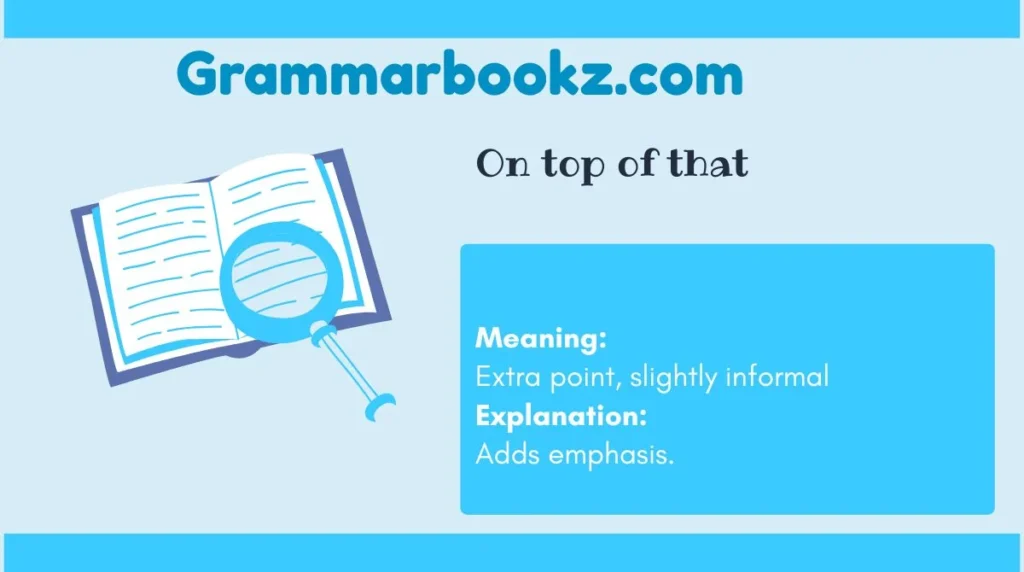
Meaning: Extra point, slightly informal
Explanation: Adds emphasis.
Grammar Note: Idiomatic phrase
Example Sentence:
On top of that, delivery is free.
Best Use: Spoken English
Worst Use: Formal documents
Tone: Friendly
Level: Intermediate
Similarity Score: 4/10
Also
Meaning: Another point
Explanation: Very common and simple.
Grammar Note: Adverb
Example Sentence:
Also, please review the file.
Best Use: Everyday English
Worst Use: Academic writing
Tone: Neutral
Level: Beginner
Similarity Score: 4/10
The next point is
Meaning: Following idea
Explanation: Very clear but plain.
Grammar Note: Phrase
Example Sentence:
The next point is customer feedback.
Best Use: Presentations
Worst Use: Casual talk
Tone: Neutral
Level: Beginner
Similarity Score: 7/10
One reason is
Meaning: Introduces a reason
Explanation: Useful for arguments.
Grammar Note: Phrase
Example Sentence:
One reason is the high demand.
Best Use: Essays
Worst Use: Lists without reasons
Tone: Neutral
Level: Beginner
Similarity Score: 6/10
Let’s start with
Meaning: Beginning point
Explanation: Friendly and engaging.
Grammar Note: Spoken phrase
Example Sentence:
Let’s start with the basics.
Best Use: Meetings
Worst Use: Academic papers
Tone: Friendly
Level: Beginner
Similarity Score: 8/10
Here’s the first thing
Meaning: First idea
Explanation: Conversational and clear.
Grammar Note: Informal phrase
Example Sentence:
Here’s the first thing you should know.
Best Use: Speech
Worst Use: Formal writing
Tone: Casual
Level: Beginner
Similarity Score: 7/10
Step one
Meaning: First step
Explanation: Instructional and direct.
Grammar Note: Noun phrase
Example Sentence:
Step one is creating an account.
Best Use: Tutorials
Worst Use: Essays
Tone: Clear
Level: Beginner
Similarity Score: 8/10
Point number one
Meaning: Ordered point
Explanation: Very explicit.
Grammar Note: Phrase
Example Sentence:
Point number one is safety.
Best Use: Presentations
Worst Use: Casual chat
Tone: Neutral
Level: Beginner
Similarity Score: 9/10
Lastly
Meaning: Final point
Explanation: Short and formal.
Grammar Note: Adverb
Example Sentence:
Lastly, thank you for your time.
Best Use: Writing
Worst Use: Mid-list
Tone: Professional
Level: Beginner
Similarity Score: 9/10
Finally
Meaning: End point
Explanation: Very common and natural.
Grammar Note: Adverb
Example Sentence:
Finally, we reached a decision.
Best Use: All contexts
Worst Use: None
Tone: Neutral
Level: Beginner
Similarity Score: 10/10
To wrap up
Meaning: Closing point
Explanation: Friendly conclusion signal.
Grammar Note: Phrasal expression
Example Sentence:
To wrap up, let’s review the key points.
Best Use: Presentations
Worst Use: Formal essays
Tone: Friendly
Level: Intermediate
Similarity Score: 7/10
In conclusion
Meaning: Formal ending
Explanation: Very academic and professional.
Grammar Note: Phrase
Example Sentence:
In conclusion, the data supports our claim.
Best Use: Essays
Worst Use: Casual talk
Tone: Formal
Level: Intermediate
Similarity Score: 8/10
Mini Dialogue Examples
Formal
“To begin with, we will review last quarter’s results. Finally, we’ll discuss improvements.”
Informal
“First of all, let’s grab coffee. Then we’ll talk.”
Business Email
“First of all, thank you for your response. Additionally, I’ve attached the document.”
Mistakes to Avoid
- Overusing “firstly, secondly” in speech
- Mixing formal and slang transitions
- Using “also” too often
- Forgetting commas after transition words
- Using “finally” when more points follow
- Sounding robotic with long lists
- Using formal words in casual texts
Cultural & Tone Tips
UK English:
More tolerant of formal sequencing.
US English:
Prefers natural flow like “first,” “next.”
Casual Social English:
Short words. Less structure.
Comparison Table
| Phrase | Tone | Best Context | Professional Level | Example |
|---|---|---|---|---|
| To begin with | Soft | Meetings | High | To begin with, we agree. |
| First of all | Friendly | Speech | Medium | First of all, thanks. |
| Additionally | Formal | Emails | High | Additionally, see below. |
| Moreover | Strong | Essays | Very High | Moreover, results show… |
| Finally | Neutral | All | Medium | Finally, we finished. |
FAQs
Is “firstly, secondly, thirdly” rude?
No, but it can sound stiff.
Is it okay in emails?
Yes, but alternatives sound more natural.
What is the most formal alternative?
“In conclusion” or “furthermore.”
What is the most polite alternative?
“To begin with.”
What should beginners use?
“First,” “next,” “finally.”
Can I mix different alternatives?
Yes. That improves fluency.
Conclusion
Using the same words again and again limits your English. Learning other ways to say firstly, secondly, thirdly helps you sound clear, confident, and natural.
Whether you’re writing emails, giving presentations, or chatting at work, the right transition improves flow and professionalism. Practice these alternatives in real situations.
Start small. Mix them naturally. Over time, your English will sound smoother and more fluent.

John Lee is an education-focused writer with a strong interest in English grammar and language learning.
He creates clear, student-friendly content to help learners improve their grammar skills with confidence.