Good communication skills mean the ability to share ideas clearly, listen actively, and respond in a way others understand and respect.
These skills shape how people see you at work, in school, and in daily life. Using the same phrase again and again can sound basic or repetitive. That is why learning alternative expressions matters.
The words you choose affect tone, confidence, and professionalism.
In business emails, strong wording builds trust. In essays, precise language shows intelligence. In conversation, the right phrase makes you sound natural and fluent.
Compare this contrast:
Formal: She demonstrates excellent verbal and written communication.
Informal: She explains things really well.
Both mean the same thing, but the tone and impact are different. This guide will help you choose the best option for every situation.
What Does “Good Communication Skills” Mean?
Good communication skills describe the ability to express thoughts clearly and understand others effectively. It includes speaking, listening, writing, body language, and emotional awareness.
Grammar form:
Noun phrase
Similar meanings:
Clear expression, effective interaction, strong interpersonal ability
Opposite tones:
Poor communication, unclear expression, weak interaction
Sample sentences:
- He has good communication skills and works well with clients.
- Good communication skills are essential for leadership roles.
When to Use “Good Communication Skills”
Spoken English
Used in interviews, presentations, and introductions.
Business English
Common in resumes, performance reviews, and meetings.
Emails / Messages
Safe but slightly generic in professional emails.
Social media
Often replaced with casual phrases like “great at explaining.”
Academic writing
Acceptable, but stronger alternatives are preferred.
Professional meetings
Used when giving feedback or describing strengths.
Is “Good Communication Skills” Polite or Professional?
This phrase is polite, neutral, and professional. It is safe but not powerful.
Tone levels:
- Polite: Yes
- Neutral: Yes
- Strong: No
- Soft: Yes
- Formal: Medium
- Informal: Low
Etiquette tip:
Better for resumes than casual chats. Avoid overusing it in high-level corporate writing.
Pros & Cons of Using “Good Communication Skills”
✔ Pros:
- Easy to understand
- Safe in all settings
- Suitable for beginners
✘ Cons:
- Sounds generic
- Lacks impact
- Overused in resumes
Quick Alternatives List
- Strong communication abilities
- Excellent verbal skills
- Clear and effective communicator
- Articulate speaker
- Effective interpersonal skills
- Professional communication skills
- Strong verbal and written skills
- Confident communicator
- Clear expression of ideas
- Persuasive communication style
- Well-spoken
- Skilled in communication
- Engaging communicator
- Fluent in communication
- Collaborative communicator
- Strong people skills
- Able to convey ideas clearly
- Thoughtful communicator
- Expresses ideas effectively
- Clear messaging skills
- Influential communicator
- Strong presentation skills
- Polished communication style
- Communicates with clarity
- Excellent listener and speaker
Strong Communication Abilities
Meaning:
The ability to communicate clearly and effectively.
Explanation:
This phrase sounds confident and professional. It adds strength to resumes and evaluations.
Grammar Note:
Formal noun phrase
Example Sentence:
She has strong communication abilities and leads meetings well.
Best Use:
Workplace, resumes, interviews
Worst Use:
Casual texting
Tone:
Professional
Level:
Intermediate
Similarity Score:
9/10
Replaceability Tip:
Use this when you want a more powerful version of the original phrase.
Excellent Verbal Skills
Meaning:
Very good speaking ability.
Explanation:
Focuses on speaking rather than writing or listening.
Grammar Note:
Noun phrase
Example Sentence:
His excellent verbal skills help him explain complex ideas.
Best Use:
Presentations, interviews
Worst Use:
Academic writing if writing skills matter
Tone:
Professional
Level:
Beginner
Similarity Score:
7/10
Replaceability Tip:
Choose this when speaking is the main skill.
Clear and Effective Communicator
Meaning:
Someone who explains ideas clearly.
Explanation:
Natural and human-sounding. Widely used by native speakers.
Grammar Note:
Descriptive noun phrase
Example Sentence:
She is a clear and effective communicator with clients.
Best Use:
Emails, resumes
Worst Use:
Very casual chats
Tone:
Neutral-professional
Level:
Intermediate
Similarity Score:
8/10
Replaceability Tip:
Great for modern business English.
Articulate Speaker
Meaning:
Someone who speaks clearly and confidently.
Explanation:
Adds intelligence and clarity to your description.
Grammar Note:
Noun phrase
Example Sentence:
He is an articulate speaker who explains ideas well.
Best Use:
Public speaking, interviews
Worst Use:
Writing-focused contexts
Tone:
Formal
Level:
Intermediate
Similarity Score:
7/10
Replaceability Tip:
Use when clarity of speech matters most.
Effective Interpersonal Skills
Meaning:
Ability to communicate well with people.
Explanation:
Includes listening, empathy, and teamwork.
Grammar Note:
Formal noun phrase
Example Sentence:
Her effective interpersonal skills improve team collaboration.
Best Use:
HR, management, leadership
Worst Use:
Casual conversation
Tone:
Professional
Level:
Advanced
Similarity Score:
8/10
Replaceability Tip:
Best when teamwork is the focus.
Well-Spoken
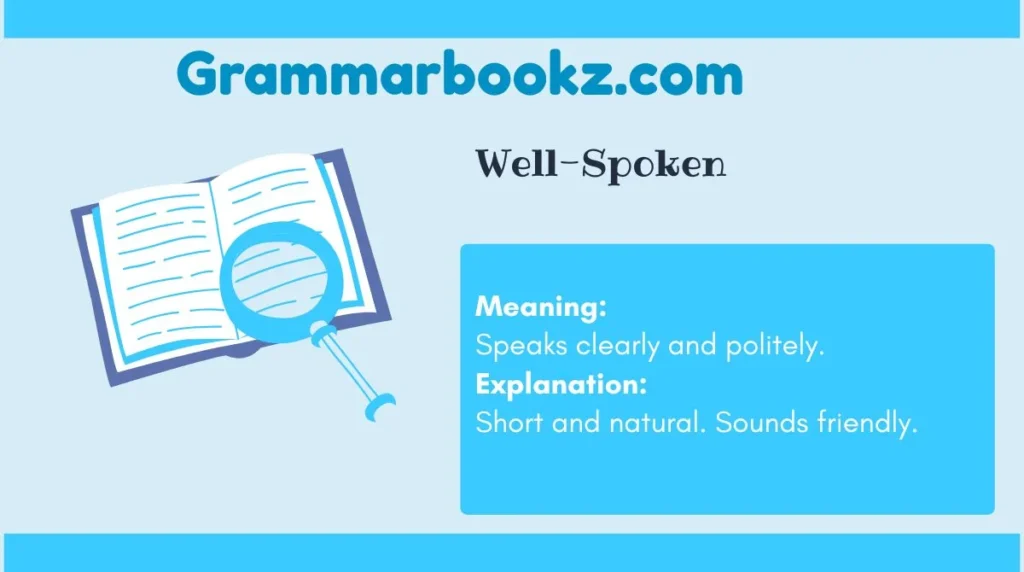
Meaning:
Speaks clearly and politely.
Explanation:
Short and natural. Sounds friendly.
Grammar Note:
Adjective
Example Sentence:
She is well-spoken and confident.
Best Use:
Casual and semi-formal settings
Worst Use:
Formal reports
Tone:
Friendly
Level:
Beginner
Similarity Score:
6/10
Replaceability Tip:
Use in spoken English.
Confident Communicator
Meaning:
Someone who communicates with confidence.
Explanation:
Highlights attitude, not just clarity.
Grammar Note:
Noun phrase
Example Sentence:
He is a confident communicator in meetings.
Best Use:
Leadership contexts
Worst Use:
Shy or sensitive feedback
Tone:
Strong
Level:
Intermediate
Similarity Score:
7/10
Strong Verbal and Written Skills
Meaning:
Good speaking and writing ability.
Explanation:
Balanced and professional.
Grammar Note:
Formal noun phrase
Example Sentence:
The role requires strong verbal and written skills.
Best Use:
Job descriptions
Worst Use:
Casual chats
Tone:
Formal
Level:
Intermediate
Similarity Score:
9/10
Engaging Communicator
Meaning:
Someone who keeps others interested.
Explanation:
Adds personality and warmth.
Grammar Note:
Descriptive noun phrase
Example Sentence:
She is an engaging communicator during presentations.
Best Use:
Public speaking
Worst Use:
Technical writing
Tone:
Friendly-professional
Level:
Intermediate
Similarity Score:
6/10
Able to Convey Ideas Clearly
Meaning:
Can explain ideas without confusion.
Explanation:
Simple and student-friendly.
Grammar Note:
Verb phrase
Example Sentence:
He is able to convey ideas clearly to the team.
Best Use:
Academic and professional writing
Worst Use:
Informal chats
Tone:
Neutral
Level:
Beginner
Similarity Score:
8/10
Mini Dialogue Examples
Formal:
Manager: Why should we hire her?
HR: She has strong communication abilities and works well with teams.
Informal:
Friend: Is he good at explaining things?
You: Yeah, he’s really well-spoken.
Business Email:
She is a clear and effective communicator who collaborates well with clients.
Mistakes to Avoid
- Using the phrase too often in one document
- Mixing informal alternatives in formal emails
- Using “communication skill” instead of “skills”
- Overusing buzzwords without examples
- Choosing speaking-focused terms when writing matters
- Using casual terms in academic essays
Cultural & Tone Tips
In US English, direct and confident alternatives are common.
In UK English, softer and polite phrasing sounds better.
In casual social English, short terms like well-spoken feel natural.
Tone matters more than vocabulary. Match the setting.
Comparison Table
| Phrase | Tone | Best Context | Professional Level | Example |
|---|---|---|---|---|
| Strong communication abilities | Professional | Resume | High | Strong communication abilities |
| Well-spoken | Friendly | Conversation | Medium | She is well-spoken |
| Articulate speaker | Formal | Presentations | High | An articulate speaker |
| Clear communicator | Neutral | Emails | Medium | Clear communicator |
| Interpersonal skills | Formal | HR | High | Effective interpersonal skills |
FAQs
Is “good communication skills” rude?
No. It is polite but basic.
Is it okay in emails?
Yes, but stronger alternatives sound better.
What is the most formal alternative?
Strong verbal and written skills.
What is the most polite alternative?
Clear and effective communicator.
What should beginners use?
Able to convey ideas clearly.
Can I use informal options on a resume?
Avoid them. Use professional phrases only.
Conclusion
Using only good communication skills limits your expression. Smart alternatives help you sound confident, fluent, and professional.
Different situations need different tones. Business writing needs strength. Conversation needs warmth. Academic work needs clarity.
By practicing these alternatives, you improve vocabulary and communication at the same time. Choose words that match your purpose.
Over time, your English will sound more natural and powerful. Practice using these phrases in emails, interviews, and daily conversations.

John Lee is an education-focused writer with a strong interest in English grammar and language learning.
He creates clear, student-friendly content to help learners improve their grammar skills with confidence.